
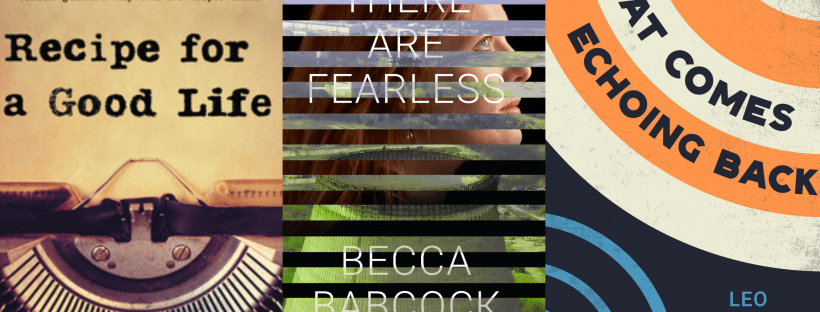
Three new novels from three established Nova Scotian authors. This is Becca Babcock‘s second book – I wrote about her first book here. This is Lesley Crewe‘s trillionth book – I wrote about her last book here. Leo McKay‘s debut story collection was shortlisted for the 1995 Giller Prize. I wrote about his self-published novel here. (After you read about nuclear meltdown and assault in the first two books, you can pick up the third one for some relief and a few laughs.)

Some There Are Fearless by Becca Babcock
Jessica grows up under the threat of nuclear disaster. She’s a child when Chernobyl happens, and it shapes the trajectory of her life. Not only does she become an engineer in the hopes of helping to prevent other nuclear disasters from taking place, she also worries her daughter’s illness is connected to her Chernobyl visit as an adult before learning she was pregnant.
Taking charge of the entire system of safety, from machinery to processes, product to personnel–the ability to visualize and direct an entire safety network, to ensure that part of that system worked together seamlessly under every imaginable circumstance. I wanted that. I wanted it to be me.
The design basis of a nuclear power plant has to consider all of the foreseeable factors that might reasonably threaten its function and stability, and it is established by imagining the maximum credible accident: the most terrible thing that designers can reasonably imagine going wrong. The problem, of course, is that sometimes, engineers don’t imagine an accident bad enough.
The story alternates between present day Halifax with her daughter Freya’s illness, and her childhood on a northern Albertan military base during the Cold War. Her relationship with her daughter is shadowed by the one she had with her mother, which was fraught with conflict. With these two major themes in play, as well as her long-term relationship with Freya’s father and re-connecting with her brother and her childhood friend Laura, this book holds the right amount of tension throughout. The way the author connects Jessica’s past and present in such a way that feels natural and inevitable is especially satisfying.
Panic enveloped me, pinning me in place. I could feel the green radioactive sludge pooling around my feet.
I could see her in front of me, Freya, my beautiful daughter, and I imagined all of it surging at her, enveloping her, like the nuclear sludge from my nightmares. Everything I’d ever tried to do to keep her safe, it was all useless.

What Comes Echoing Back by Leo McKay Jr.
I was excited to see that Leo McKay Jr. had a new book coming out. His last traditionally published book was Twenty-Six (2003), and he self-published a book in 2013 called Roll Up the Rim. Can we expect the next one in 2033?
The characters in McKay’s book are high school students, which suits nicely since McKay has been an English high school teacher for about 30 years. The main setting of the story is Hubtown, a fictional place in Nova Scotia based on the town where the author lives (as well as his characters from Roll Up the Rim.)
Sam has moved to Hubtown to live with her uncle in order to have a fresh start at a new school, in a new town, with a new name.
She did not need people to help her… People were what had broken her. Putting herself back together she could do on her own.
Robot has just arrived back in town after serving a year at the juvenile detention centre for manslaughter, and is trying to pick up the pieces of his life while keeping a low profile. As a hopeless alcoholic, his mother isn’t much help to him, and to make matters worse, while he was gone, she sold the only thing that mattered at all to him – his guitar.
In the dark of the house, that bit of music got inside his chest and fluttered around like a bird that had gotten in there. Something alive.
The book takes us back and forth in time, filling us in on the characters’ back stories as well as their present situations. What happened to Sam that resulted in a name-change and a move? How did Robot end up in prison?
Sam and Robot meet in music class, both desperate to move on with their lives. For both of them, music becomes a source of expression and healing, as well as a way toward friendship. Alexander MacLeod calls it “a hymn to the healing power of art.”

I love the inclusion of Alan Syliboy‘s art. One of the characters has a print of his butterfly on her wall. His whales are my personal favourite. He also writes childrens’ books.
Recipe for a Good Life by Lesley Crewe
Since reading The Spoon Stealer and Nosy Parker, I seem to be hooked on Lesley Crewe. She writes with a lot of heart and her books are such fun to read.
Kitty is sick and tired of writing novels about the very successful Harry Gunn and threatens never to write again. So, her publisher sends her to Cape Breton on a writing retreat. It’s the 1950s, so Cape Breton is a complete mystery to her and it takes three days to get there from Montreal in her car with her dog. She finally finds the rental property down a dirt road in the middle of nowhere. She has no idea what’s about to hit her.
So far in the last twenty-four hours she’d talked to more people here than she usually did in a month in crowded Montreal. So much for solitude.
Reasons to read Recipe for a Good Life:
1.Dogs! So many cute dogs who have nice owners and who stay alive. (And it was so much fun to see Jersey May make an appearance!)
2. Ethel. I wonder how many Ethels there are in the world? Ethel listens in on the party line to hear all the news and then immediately spreads it far and wide. And she doesn’t always get it right.
3. Bertha. I love the Berthas of the world. I wish I was a Bertha. Bertha’s family is huge (30 grandchildren and 11 great-grandchildren), she is happy and bustling, she makes everyone feel welcome all the time, and always knows just what to say.
4. Wallace. Wallace is a big teddy bear of a man who attracts dogs, chickens and children like a magnet, and loves to bake. He’s also happy to help anyone with anything at any time. Did I mention that he loves to bake?
5. The food! Speaking of baking, the characters in this book are always cooking, baking, or eating. It will make you want to eat copious amounts of tea biscuits and scones. With tea, of course.
6. The Old Campbell Place. This is the small, old shack that is rented out to Kitty who has come to Cape Breton from Montreal on a writing retreat. It’s a complete shambles when she arrives, but ends up being homey and cozy and exactly the kind of place I would love.
8. The characters. Lesley Crewe’s talent is in creating characters readers can relate to and cheer on. Ones that can make us laugh and cry, and that we’re sorry to say goodbye to at the end of the book.
A favourite line: “Even when she was alone Kitty kept her door closed, so all the words stayed with her instead of roaming around the apartment.”

 Consumed by Ink
“Dogs who have nice owners and who stay alive”–wonderful! I might need to read this book just for the Jersey May appearance.
Shall I call you Bertha from now on?
Uhh, maybe not. Maybe if it was Lady Cordelia or something. Lol
Did you know Jersey May was going to be in the book??
Dear Lady Cordelia,
The news of Jersey May’s appearance was a delightful surprise!
🙂
I think Recipe seems like it would be fun. I’m putting it on my list!
Yay! I hope it agrees with you, Kay! 🙂
Three very different tales, they all sound compelling. I’m so glad the dogs survive!
That’s the most important information in this whole post, right?! 😉
Why do so many authors kill off dogs? Such a cheap way of manipulating readers. Kudos to Lesley Crewe for keeping hers going. Her book sounds delightful.
I’d be up for reading the last one!
I think you’d like it!
I’m quite sure I said this last time you reviewed a Lesley Crewe, but I need to read a Lesley Crewe!
There are lots to choose from! And they’re pretty quick to read!
Chernobyl stoked such a visceral fear for me as a child that I have found it fascinating to read and watch things about it. The HBO series is absolutely amazing (on Crave in Canada, worth the subscription) so I would like to read the first novel. It’s funny that you are wondering if you’ll have to wait until 2023 to read McKay’s next book; I was just thinking about putting in an ILL for his first (I enjoyed Like This, but never finished Twenty-Six, for no reason, just got distracted). And you already know I’ve collected a couple of Lesley Crewe novels thanks to your recommendations; but I think it’s a myth that people in cities are less friendly/talkative than people elsewhere…I think it depends on the people, not the place, and I’ve lived in tiny and huge and found all sorts of variations. Why can’t people in small towns be unfriendly and reclusive and people in cities be chatty and amiable?
Yes, I completely agree! There are many unfriendly people in small towns, and friendly people in cities. My daughter in Montreal has amazing neighbours who we got to know the day she moved in!
I’ve read Twenty-Six, but not Like This.
I didn’t know you’re fascinated by Chernobyl. You should read the book, then. I thought it was well done.