
Kilmeny of the Orchard is a novel that arose from the short story “Una of the Garden,” which was published in 1908. In Magic Island, Elizabeth Waterston writes about the changes that were made by LMM as she re-worked the story. For example, the setting change from “garden” to “orchard” suggests “a development in Montgomery’s vision of love, from a garden’s suggestion of the fragile prettiness of flowers, to the orchard’s implication of the sturdiness of trees, bearing fruit.” During the time she was revising the story, “Montgomery had become secretly engaged to Ewan MacDonald. Many of the revisions reflect the new perspective he brought into her life.” Elizabeth Waterston also suggests many of the possible poems and books that may have influenced LMM as she wrote, like Walter Scott’s Lady of the Lake, Gene Stratton Porter’s Girl of the Limberlost, James Hogg’s Kilmeny, as well as Fairy Tales by Hans Christian Anderson.
Kilmeny was published in 1910, soon after the success of Anne of Green Gables and Anne of Avonlea. It was noted as a “move into adult fiction”, but her publisher urged her back to The Story Girl to please her “young adult” audience. In Magic Island, it is said that LMM wrote of Kilmeny that “It is a love story with a psychological interest” meaning that Kilmeny’s inability to speak is due to a psychological problem rather than a physical one. After being examined by a doctor, it is concluded that her vocal chords are fine; so is Kilmeny being punished for the sins of her mother? Or is she psychologically affected by her mother’s treatment of her?
I thought the story behind Kilmeny’s strange existence was interesting, but found it hard to believe that she would have turned out to be so sweet and compliant. Even with the sanctuary of that beautiful orchard.
And, here are a few more complaints I have about the book:
Reasons Kilmeny of the Orchard may be my least favourite book by LMM (needless to say, none of these things seemed to bother me when I read it as a teen):
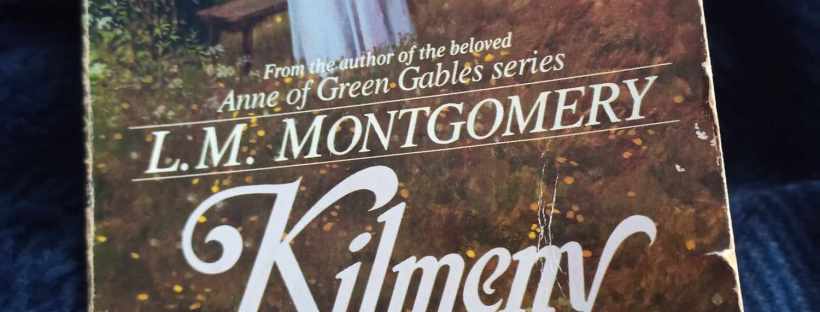
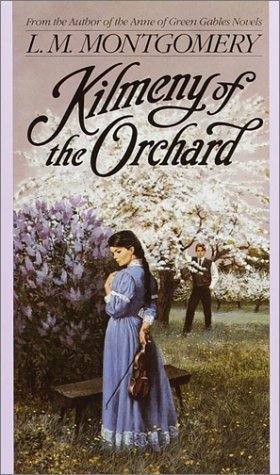
1.The cover of my book. More specifically, the body language of the people on the cover of the book.
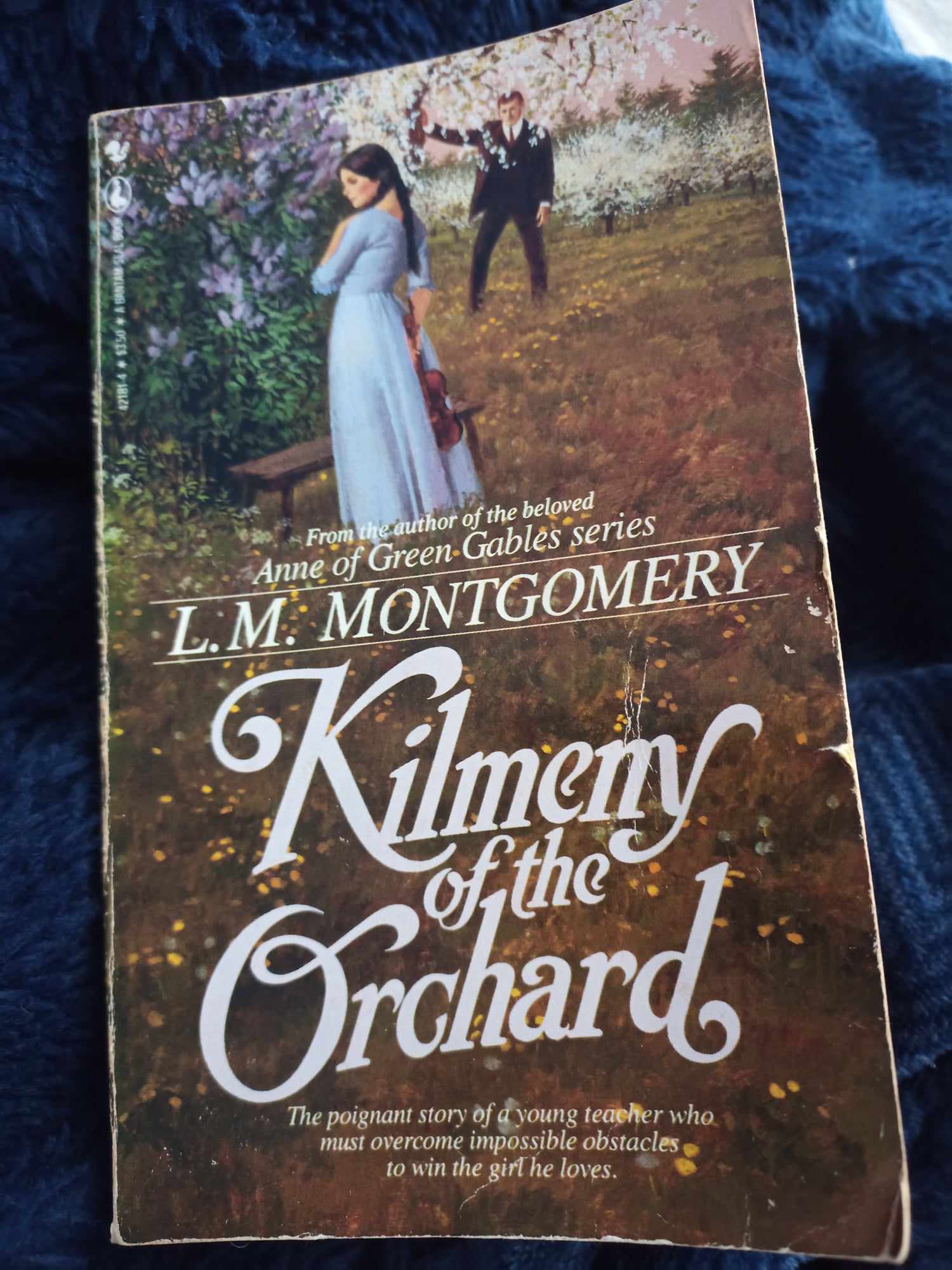
2.The huge emphasis on looks – I thought significantly more so than her other books. When Kilmeny was young, her mother told her she was ugly and smashed all the mirrors in the house. So, Kilmeny grows up believing she is ugly. But, instead, she is the most beautiful woman Eric has ever seen, and she seems to strike everyone dumb when they lay eyes upon her. When Eric’s father comes to meet her, all his misgivings are laid to rest when he sees how beautiful she is. It is noted in Magic Island that, “Like Kilmeny, Montgomery sadly needed support and reassurance about her value–as an attractive woman, not just as a successful professional writer.” Also, like Kilmeny being trapped by her circumstances, LMM likely felt trapped by her “spinster” life with her grandmother until Ewan came to ‘rescue’ her. This perspective gives the story a bit of a fairy tale feel, and maybe looking at it as a fairy tale helps make some of the complaints I have easier to swallow.
3. She’s only 18-years-old! When I was thirteen, I probably thought nothing of this, but it doesn’t sit well with me anymore. The worst part is, even Eric Marshall acknowledges that she is just a child.
“What a child she was–what a beautiful, ignorant child, utterly unskilled in the art of hiding her feelings! But why should she hide them? They were as pure and beautiful as herself.”
“She was, after all, nothing but a child–and a child set apart from her fellow creatures by her sad defect.“
4. Love-at-first-sight. I think this is common in romance books, but the idea that one cannot go on living without a person they have only known for a few weeks goes a bit too far for me.
“He was face to face with the knowledge that he loved Kilmeny Gordon with a love that comes but once, and is for all time. He wondered how he could have been so long blind to it. He knew that he must have loved her ever since their first meeting that May evening in the old orchard.”
“I may be but a lad, but I know that Kilmeny is the one woman in the world for me. There can never be any other.”
5. Some of the phrases are just too much.
“Kilmeny’s mouth is like a love-song made incarnate in sweet flesh.”
“He watched her lithe, graceful motions with delight; every movement seemed poetry itself. She looked like a very incarnation of Spring–as if all the shimmer of young leaves and glow of young mornings and evanescent sweetness of young blossoms in a thousand springs had been embodied in her.”
6. Representation of “foreigners.” Poor Neil Gordon is doomed from the start given his Italian heritage. He’s written off as a bad seed and portrayed as one, too. The best ending LMM can give him is to let him escape the town and never come back. Maybe the place he ends up will be kinder to him.
“Neil’s smart and a great worker, they tell me. But folks hereabouts don’t like him. They say he ain’t to be trusted further’n you can see him, if as far.“
“He’ll do you a bad turn if he can, I’ve no doubt. Them foreigners can’t be trusted…“
“He must be taught his place. I mistrust we have all made more of him than we should.” (Keeping in mind that they have raised him as their own since he was a baby.)
7. Old ideas of men and women. I know this is often the case in old books, but LMM doesn’t usually play it up as much in her own books – her ideas are usually more progressive. Kilmeny is SO innocent and SO inexperienced that she’s JUST LIKE A CHILD.
“It will be my sweet task to teach her what love means, and no man has ever had a lovelier, purer pupil.“
“He knew that [his kiss] had opened the gates of womanhood to Kilmeny.” (Don’t flatter yourself, Eric.)
8. The need to “fix” Kilmeny before there can be a happy ending. Kilmeny refuses to marry Eric because she feels her inability to speak means she’s not good enough for him, that he deserves better. To Eric’s credit, he says he doesn’t care about that, but her “healing” becomes part of the happy ending anyway.

The funny thing is, this book is something I imagine young Anne Shirley would write, with all her romantic notions of dark brooding men, dazzlingly beautiful women, and unavoidable tragic circumstances that keep lovers apart. I’d like to think LMM had Anne Shirley on her mind when she wrote this story.
So, do I like this book? Not really. (Shocking, I know. It has finally happened.)
Did I enjoy reading it anyway? I did. It still has some of LMM’s characteristic literary traits to recommend it. There is some excellent descriptive writing (although, there is also some that is over-the-top), and she has created some fun characters. Eric Marshall is a bit boring, but the Williamsons made me giggle.
“Her husband came to the kitchen door and sat down on the steps to enjoy his evening smoke, talking between whiffs to his wife of Elder Tracy’s church row, and Mary Alice Martin’s beau, the price Jake Crosby was giving for eggs, the quantity of hay yielded by the hill meadow, the trouble he was having with old Molly’s calf, and the respective merits of Plymouth Rock and Brahma roosters. Mrs. Williamson answered at random, and heard not one word in ten.“
My advice to you, if you plan to read Kilmeny of the Orchard, is to think of it as a fairy tale with stereotypical heroes and villains and an unrealistic happy ending.
(P.S. It did not escape my attention that Kilmeny and Eric are never–not once–driven inside by the black flies.)

Posts by others who have participated in the readalong. (If I’ve missed any, please let me know or add a link to your post in the comments!)
#ReadingKilmeny: A “Kilmeny of the Orchard” Readalong: My introductory post
“The murmur that rings forever” (#ReadingKilmeny): Sarah Emsley
“A rather doubtful experiment” (#ReadingKilmeny): Sarah Emsley
“A beautiful voice” (#ReadingKilmeny): Sarah Emsley
Buddy Reads: Kilmeny of the Orchard by L.M. Montgomery & The Waterfall by Margaret Drabble: Rebecca @ Bookish Beck
Kilmeny of the Orchard by L.M. Montgomery: Laila @ Big Reading Life
Review: Kilmeny of the Orchard by Lucy Maud Montgomery: Hopewell’s Public Library of Life
 Consumed by Ink
So, do I like this book? Not really. (Shocking, I know. It has finally happened.)
Did I enjoy reading it anyway? I did. It
Agree!!! Someone said in a comment on my blog that LMM didn’t want to write this–well make over a short story into this. It shows!
Thanks for linking
It’s funny to think I can enjoy reading a book that I don’t really like. It doesn’t happen very often!
LOL I know!
Thanks so much for this, Naomi! I agree completely with all of your points. It was hard to come to terms with how much I disliked this book, given how much I have always loved the LMM books I’ve read. I kept cringing as I read this one and found it downright shocking in its bigotry. Your description of it as being something young Anne Shirley might write redeems it somewhat for me, so thanks especially for that. It’s definitely best to think of it as akin to a fairy tale–an unrealistic, overblown romance.
You’re very welcome, Marianne. Even I couldn’t make myself believe this was a good book. I tried! Imagining it was a story written by a young Anne for Diana’s entertainment helped it go down more easily. I can imagine them swooning over it as they stroll down Lovers’ Lane. Lol
Excellent points! You know my feelings about this novella. But I’M still glad I read it and I thank you for hosting the readalong and prompting me to read it!
We might all be glad, though, that it wasn’t very long! 🙂
It seems we were all disappointed in this one! You and I quoted the same purple line about Kilmeny’s mouth.
That line! Hahaha
This is one of the only LMM books I’ve never reread. I was pretty young when I read it so a lot of things you mention probably didn’t stick out to me but I do recall not finding Kilmeny very interesting in the way that LMM’s heroines usually were.
I wonder if it has something to do with the fact that it’s written from Eric’s point of view. If LMM had written from Kilmeny’s–like she normally would–I wonder how it would have been different?
That’s a good point. That perspective means Kilmeny doesn’t seem to have much agency or feel like a fully realized adult woman.
I agree with all your complaints and I agree with Marianne that you’ve summed it up beautifully by saying it’s something the young Anne Shirley might write. I too disliked it—and yet am glad to have read it again after all these years. The story behind this novel’s creation is fascinating. It makes sense that it isn’t one of LMM’s best books because it was, from the start, a book that she did not want to write.
It makes me wonder what she was thinking when she wrote it. What was swirling around in her head? The fact that it kind of sticks out as an outlier in her work makes it very interesting and totally worth reading!
Yes, well said–it’s worth reading because it stands out as different. I’m really glad we decided to read this one. It’s kind of amazing to me that she persisted in writing it, even though she was unhappy about the entire project.
Yes! Anne Shirley would definitely have written this, how funny – and then she would have found it when she was older and torn it up in anger at herself!
And thrown it in the fire! Lol
It *is* still interesting to read books that you don’t particularly enjoy when you’re familiar with the author’s writing more generally, to see how ideas and characters repeat or evolve, but I think that single reread is enough. lol (Well, if you didn’t have a tonne of books on your TBR maybe the intellectual exercise would continue to bring up more layers, but, sheesh, it’s a trial for sure, when you have other good books waiting!) The idea that she’s 18, I’m not sure it bothers me in the same way; when you reverse the pronouns, it reminds me of conversations I’ve overheard between girls of that age, talking about boys (their seeming incapacity to pick up after themselves in their first shared apartments, or their inability to go to bed at a decent time when they work the next day), when their maturity levels aren’t matched at that young-adult stage. “He’s such a child.” But all that stuff about purity is hard to take about any age, eh? /sighs What does that sentence even mean? lol (Still an LMM fan, just to be clear! Love your idea that Anne wrote this one.)
That’s a good point about reversing the pronouns. Maybe it’s the way I imagine it in my head as I’m reading it. Or maybe it’s the emphasis on it and/or how it’s connected with the beauty and the purity, too. It feels to me like LMM imagined what a man’s ultimate fantasy wife would be like and then wrote about it. I wonder what a man would have said had she asked one. (Maybe she did!)