
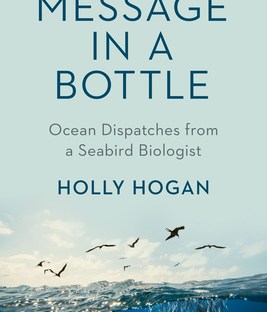

Message in a Bottle is a book that combines some of my favourite things: the ocean, seabirds and other marine animals, biology, snow and ice, and Atlantic Canadian stories. Holly Hogan is now one of my heroes, literary and otherwise. (And she’s married to one of my other literary heroes – Michael Crummey. The two of them were finalists for the 2023 BMO Winterset Award – the stuff of a book nerd’s dreams.)
Message in a Bottle is about the important role the ocean plays in our lives, in the lives of wildlife and ecosystems, and how we are destroying it. It’s a plea for us to be more careful, more thoughtful about the choices we make. “Because it’s not just about the fish we eat, the whales we are fascinated by, the beautiful sunsets, the poetry the ocean inspires. Without the sea, we can’t breathe.”
Holly writes about microplastics, in particular. Most of us know about the harm big pieces of plastics can do – we’ve all seen videos of turtles with straws up their nose, or read articles about animals dying of starvation because their stomachs are full of plastic bags. Microplastics are tiny bits of plastic that can no longer be seen by the naked eye, but that are everywhere in the oceans and inside the animals that live in the ocean. There’s a lot of distressing stats about plastic in the oceans. But this book contains so much more than that.
Message in a Bottle is also about the joy and majesty of the ocean and the creatures that live in and around it, what we can learn from them, and the passion they inspire.
I learned so many cool things. First of all, who knew ocean currents could be so interesting? I kept referring back to the ocean current map at the beginning of the book whenever Holly was talking about a different part of the ocean and how it connected to the rest. “There is really only one ocean, and what happens to it in one region affects all others.”
“Ocean currents are central to life on earth. They explain the locations of all the richest fishing grounds in the world; why fires have been raging in California; how a balloon from a six-year-old’s birthday party in Manhattan can end up in the stomach of a whale off the coast of Norway; and how a disposable diaper makes its way into the diet of a polar bear on an island at the northern tip of Labrador. They explain the distribution of plastic in the ocean and are intricately linked to climate change as they distribute the heat absorbed by the ocean from the atmosphere. They explain the circulation of water around the planet, driven by winds, tides, water temperature and density, and the very origin of over half the air we breathe.”
I spent a lot of time googling all the different seabirds she mentions – I wanted to get a good look at each one. Did you know that frigatebirds can “fly over the ocean for months at a time, without ever landing on the water” and “sleeps with only half its brain for ten seconds at a time, the other half alert”? Did you know that the wandering albatross can sustain 130km/hour “for hours on end”? In her early days, Holly spent hours on small islands with birds, just observing. “Seabirds at the surface can be directly linked to the ocean temperature, chemistry and marine life below the surface; they are a handy indicator of what might be going on in the ocean’s depths.”
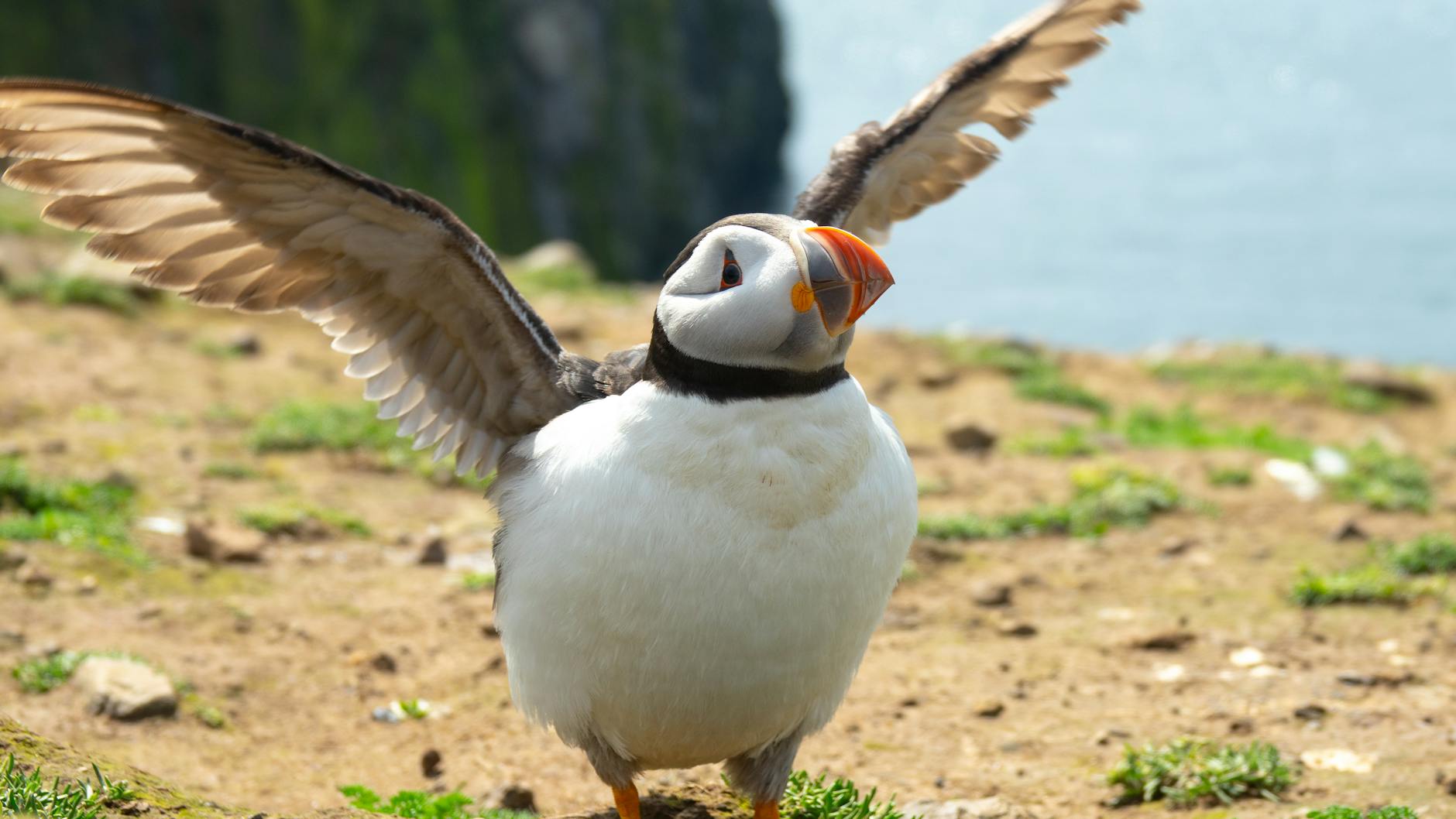
“We began to encounter large rafts of birds sitting on the water, diving or skittering over the surface as the boat approached. And as we drew nearer, the racket of the colony: Kittiwakes complaining their own names in a high-pitched nasal ‘Kitti-WAKE! Kitti-WAKE’! Murres erupting in a series of guffaws like old men laughing at their own jokes. Thousands of birds greeting, warning, sparring, amplified against the rocky cliffs. The deep, penetrating funk of all that guano–its own force. At the last moment, the whirr of hundreds of puffin wings as they cleared the hillside in a panicked flight over our heads. I was astonished but tried to remember to keep my mouth closed.”
Other interesting things I learned (directly quoted from the book): an encyclopedia and a dildo have both been found in the belly of a codfish; UNESCO estimates that 100,000 whales and other marine mammals die from plastic ingestion every year (and that’s just the mammals); phytoplankton are responsible for over half the photosynthesis on earth as well as over half the oxygen we breathe; the Great Pacific Garbage Patch is about 1.6 million square kilometers; the Antarctic Circumpolar Current moves a hundred times the volume of all the world’s rivers in one second; on average, adults consume at least 50,000 microplastic particles a year, children about 40,000 (levels were drastically higher in people who drank bottled water). And then there’s flame retardants. I’m starting to wonder how so many of us are still functioning. (Maybe we aren’t!).
Holly takes us on some of her sea outings and adventures from over the years, but most particularly the one she made to the Antarctic in 2017, renewing my desire to go there. She also talks about new technologies and the progress we’re making.
“Antarctica is a refuge for hope. It demonstrates not only that we have the potential to cause devastating destruction, but also that we have the capacity to work together, to rebuild and restore our damaged planet. That recovery is possible.”
I absolutely love this book. Holly Hogan can write with the best of them, and every page is soaked in the passion and enthusiasm she has for her work and for the message she wants to communicate.
P.S. I really wanted to see that purple dress Holly found at Frenchy’s to wear to the Gillers, but I couldn’t find a picture of it online.
 Consumed by Ink
This sounds lovely – I am hopeful that we can somehow figure out how to live without plastic as the ubiquitous nightmare it is currently. That is SO sad about the mammal death figures.
Happily, she does a fabulous job of balancing the good with the bad, so you don’t go away feeling burdened with a hopeless situation.
This sounds like a highly worthwhile read — educating and inspiring. And anyone who shops at Frenchy’s for their Giller outfit deserves to be heard!!
Yes to all of this! 🙂
This sounds really interesting! I’d love a Pacific Coast version of it! And I love when it turns out 2 authors I like are married to each other.
Maybe there is a Pacific Coast version by another author. If you find one, let me know!
I’m sure I would enjoy this, too, for the seabirds and the environmental conscience. I’m glad she was able to convey joy as well as concern. And it’s always fun to find out that authors are a married couple.
I often thought of you while reading it, Rebecca!
Everywhere you look people, businesses, governments are making decisions that provide short term profit while making the planet unliveable for humans, probably some time this century. We have known exactly what we are doing since Rachel Carson and David Suzuki, but are we going to stop.
Good question. I don’t really know what it’s going to take…. I suspect I won’t be around any longer by the time we have a definite answer. I’m an optimistic person, though, so I’m hopeful.
Thanks for sharing this one! As a mad birder, Message in a Bottle sounds foolproof—I too love factoids and Holly’s book seems to revolve around them. And what a power couple (her and Michael Crummey!). For a totally fictional recommendation (but in the theme of ocean currents) you should check out A Tale for the Time Being by Ruth Ozeki. In part: “Across the Pacific, we meet Ruth, a novelist living on a remote island who discovers a collection of artifacts washed ashore in a Hello Kitty lunchbox—possibly debris from the devastating 2011 tsunami in Japan.”
You know, it’s really about time I read that book, so thanks for the nudge! And you would totally love Message in a Bottle. 🙂
I will and I’ll send you a message not in a bottle about it!
I’ve never met his wife, but Michael Crummey is probably one of the kindest authors I’ve ever met. What a nice man he is, so no doubt his wife is just as amazing.
Microplastics really scare me, I can’t think of anything I understand less but am more scared of…we just don’t understand what’s coming or the long term affects
The tiny things we can’t see with our eyes and the things we know next to nothing about are the scariest!
I have never met Michael Crummey, but he strikes me as a kind person, so it’s nice to hear it confirmed! 🙂
You’ve already convinced me about this one! Great photos here too.
It’s SO good! 🙂