
Literary Wives is an on-line book group that examines the meaning and role of wife in different books. Four times a year, we post and discuss a book with this question in mind:
What does this book say about wives or about the experience of being a wife?
Don’t forget to check out the other members of Literary Wives to see what they have to say about the book!
- Kay at What Me Read
- Rebecca at Bookish Beck
- Kate at Books Are My Favourite and Best

Wikipedia synopsis: Janie Crawford, an African-American woman in her forties, returns to her old town, after a year-long absence, and recounts her life story, along with the time she had been gone to her friend, Pheoby.
Warning: Spoilers ahead!
As part of an experiment to see if I can get myself listening to fiction on audio as well as nonfiction, this is the first time I have listened to a Literary Wives book rather than read it. I may not have caught every single thing that was said, but I loved listening to this story, and it has given me hope that I might be able to move from strictly nonfiction on audio into some fiction as well.
Because this book was written in 1937, it’s considered an important work of feminism. And I can see why. As Janie matures, she becomes unapologetic about what she wants in life and in a man, and she goes after it. First, however, she has to get through her first two marriages.
Their Eyes Were Watching God is also an important and interesting look into African American lives in the South at that time: racial views, vernacular speech, gender norms, relationship norms, etc.
What does this book say about wives or about the experience of being a wife?
Janie was first married off to a much older man at the age of sixteen. Her grandmother arranged this to assure Janie would have someone to look after her, but also to make sure she didn’t get into ‘trouble’ with a man before she was married. Janie expected that after the wedding, there would be love. She was sorely disappointed.
Janie leaves her first husband for Joe Starks, a smooth-talker who convinces Janie he will treat her the way she deserves to be treated. Joe becomes the mayor of an all-Black town and the owner of a store. He might believe he’s treating Janie well by trying to mold her into what he thinks a mayor’s wife should be, but in Janie’s view he’s just stifling her and preventing her from socializing with the other members of the community.
Janie doesn’t want to be anyone’s property, or be told what to do and how to act; she wants to be free to do what she wants and to enjoy life. But she also wants to be loved.
She comes closest to this way of life with her third husband, Tea Cake. She loves him and feels loved by him, and he allows her to do what she wants. I would have to argue, though, that he still doesn’t consider Janie his equal. Not when he tells her to put her own money away because he wants to be able to provide for her. And certainly not when he beats her to demonstrate to others that Janie belongs to him. But Janie seems to be okay with these things, and accepts his explanation that he beat her because he loves her so much. I have a hard time understanding that logic. Nevertheless, Tea Cake makes Janie happy, and most importantly, doesn’t restrict her life the way her first two husbands did.
“Two things everybody’s got tuh do fuh theyselves. They got tuh go tuh God, and they got tuh find out about livin’ fuh theyselves.”
Question I have: Would Janie have been content after the death of Jody as a newly free, independent woman if Tea Cake hadn’t come along? Or did she need Tea Cake to help her get to where she is at the end of the novel?
Join us in December for Euphoria by Elin Cullhed!
 Consumed by Ink
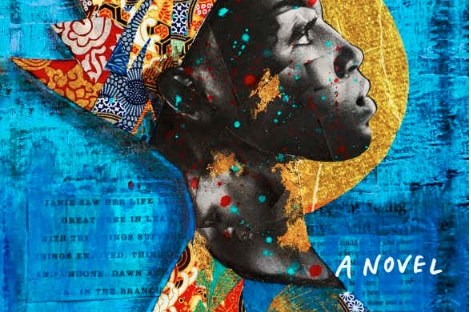
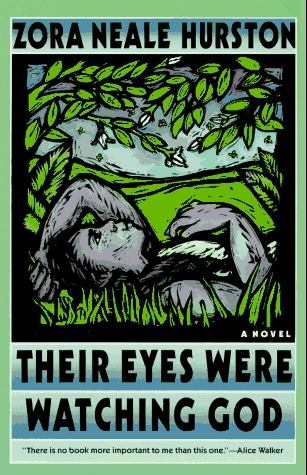
That first cover is so different! I am sheepish now because I remembered that Joe hit her … but not Tea Cake. I agree that her third marriage was the closest to being what she wanted out of life, but it is also interesting to ponder whether she could have been happy and respected as a widow in her town. I noted that she remained childless, and that that didn’t appear to be an issue.
I didn’t even think about the fact that she remained childless! There could be a whole discussion out of that alone. Why might she have wanted to be child-free? Why might the author have made that decision? It’s certainly a lot easier to do what you want when you don’t have kids…
The funny thing is, I remember the time Tea Cake hit her because it surprised me, but not so much Joe hitting her, maybe because it *didn’t* surprised me?
Agree – I was surprised when Tea Cake hit her. But I was also surprised by her demonstrative jealousy when there was a young woman hanging around Tea Cake (did she whack him then???). I can’t imagine she would have expressed the same level of emotion (jealousy) over the first two husbands.
I can’t remember if she whacked him. I do remember how upset she was, though. I don’t think she would have cared much if her other two husband’s had cheated!
I think part of Janie’s journey was to find love. However, I personally had that same thought in this reread—that I wished she had just decided to stay a rich widow. It’s a different time and place, but I didn’t think much of any of her husbands.
It’s realistic to assume she would want to find someone to love – most people do. But how does her search for love intertwine with her search for selfhood? I found it hard to separate the two things in this story. Like she couldn’t have found one without the other.
Maybe you’re right. I’m not sure.
I read and reviewed this a while ago, and was much troubled by the way Janie accepts being beaten: I wrote:
“Tea Cake slaps Janie around, not to show her who’s boss, but to show his mates, who then admire him for being able to raise a bruise. Their wives are so tough you can’t see it when they get beaten up.”
It’s one of those books that are a challenge, because while we recognise how ground-breaking the book was, we struggle to accept that values and attitudes that are totally unacceptable now, were different then.
Agreed, Lisa! If I recall correctly, they were also impressed because the bruises showed up better against her lighter skin. Parts of it were hard to read. I had to keep reminding myself it was written 90 years ago and that hopefully things are a lot better now. Hopefully!
I just hope that if anyone is teaching this novel now, that the problem of family violence isn’t swept aside by discussions about the racism.
Hopefully they tackle all of it!
I read this for book group four years ago and struggled with it a bit. I found it difficult to connect to Janie and how she seemed to be solely led by emotion. However, I found the history of the novel and its contemporary importance much more interesting – there’s a good essay by Alice Walker ‘rediscovering’ the novel in the 1970s.
Yes, I found its historical significance really interesting. It’s a treasure for that reason alone.
Thanks for recommending the essay by Walker – I will have a look for it!
I keep meaning to read this, but never seem to get round to it!
That’s exactly where I was, too. LW has helped me to finally pick up several good classics over the years!
I read this about eight years ago and loved it. I found it to be so full of life in all its complexity, so vibrant. I’d reread it!
Vibrant is a good word for it!
I like your question about what might have happened if Tea Cake hadn’t turned up? I’d like to think she would have found her way to an independent life – she knew what she wanted (from her first love, Johnny, to wishing to be sitting on the porch of the shop chatting with others), and equally knew what she didn’t want. I would hope that she was wealthy enough to make her own choices.
I agree – I think she would have enjoyed her independence. But she might have also continued longing for love and adventure.
Interesting that this book was written SO long ago, and yet it grapples with issues that many modern day women still do. Sigh, we have not come far enough!
In many ways, it didn’t feel like an old book at all. It really gets into the nitty-gritty of life.
This is one of those iconic books that I came to late, just a couple of years ago. I listened to it, which is how I consume most books these days, and within a very short while was ‘inside’ her recreation of Southern Black speech, of which of course she was a student.
I was sure Tea Cake was just a user and was surprised when he turned out to be just the husband she needed. That he had to demonstrate his manliness to his mates was both to be expected and disappointing.
I also expected Tea Cake to use her and leave her. I was so glad that he stayed, despite his flaws!
Listening to it was a great experience.
I read this for the first time this past year and while I can see how it was a work of feminism for its time, none of Janie’s relationships felt good or healthy to me. It was harder than I expected for me to not examine it all through a modern lens.
I agree – it was hard not to see it through a modern lens. But historically and literature-wise, I thought it was a stunner.
Hurston is so fascinating, and how Alice Walker worked to ensure that future generations of readers could ocnnect with her work (the original essay in Ms Magazine that Laura recommends above is also collected in some other places in books) is just as fascinating. If you’re intrigued by Hurston, you might want to try searching through ILL for video options: there are a couple of films that I found just riveting..
Thanks for that idea! Hurston’s book opened up a whole new world.