
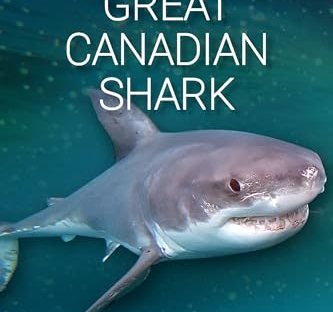
It’s hard to say who I admire more: a person who spends chunks of their life underwater with oxygen tanks strapped to their back, or a person who spends chunks of their life on their feet with a backpack filled with necessities strapped to their back.

In Search of the Great Canadian Shark by Chris Harvey-Clark (Pottersfield Press)
There has been a lot of talk about sharks in the waters of Nova Scotia in the last few years. There have been sightings by beach-goers as well as two attacks in recent years, one that injured a swimmer (2021) and one that killed a dog (2023). The rarity of shark attacks in Canada is one of the reasons these attacks got people talking.
Chris Harvey-Clark says sharks have always been here, but now we are starting to notice. They may have always been here, but there are two factors resulting in possibly a larger population of sharks as well as a longer visiting season: there are more seals than ever in our region, and climate change is warming up our waters. As well, I learned from Harvey-Clark’s book that Nova Scotia has been getting an increasing number of young sharks in our area, and young sharks are only just learning and experimenting with what and how to eat. Combine this with low visibility and the likelihood of mistaking something else for food is a concern.
I should probably not have read this book during the summer when I was trying to enjoy swimming in these very waters that are discussed in the book. But the water has never been so warm and lovely, so I went in anyway. Something Harvey-Clark encourages us to continue doing. Just maybe not right next to a group of seals romping about.
“The year 2022 marked the warmest year on record in the ocean around the Maritimes, and the entire region is warming fast, at a rate above the 94th percentile when compared to oceans globally. Only the Arctic is warming faster. Warm water species are coming here and staying longer each summer, in some cases even establishing themselves year round. There are schools of amberjack under my boat, seahorses and triggerfish are present every summer, warm-water Maryland blue crabs have set up local populations. Things in the northern ocean are far from normal.”
In Search of the Great Canadian Shark is not strictly about sharks. It’s a memoir about Harvey-Clark’s experiences with diving from the time he was in high school; he’s been doing this for decades. Diving for geoduck clams off the west coast of Canada is how he paid his way through school. Then he spent a lot of time searching for the elusive Sixgills and Greenland sharks: sharks that live in deep, cold water where it’s dark and spooky. (Those are my words, not his.) He’s also gone swimming with Tiger sharks in the Bahamas and beavers in the Cap Chat River in Quebec. And he was just as nervous about swimming with the beavers as he was with the sharks.
Other cool things I learned:
- Torpedo Rays can grow up to 6.5 feet and give off a shock of 200+ volts of electricity. And they can now be found off the coast of NS.
- Early physicians used to use the electricity from torpedo rays to treat medical conditions like epilepsy, gout, and difficulty in childbirth (they placed the live ray right on the pregnant belly!).
- Greenland sharks are the most long-lived vertebrates on the planet and have a suction technique to aspirate prey.
- Tiger sharks like to sneak up behind you.
- Sixgill females don’t sexually mature until they are 14 feet long and decades old. Then they are capable of having huge litters that emerge dozens at a time, of fully capable 2-foot-long sharks.
- Geoduck clams exist. I had no idea.
- Young white sharks will “test bite novel objects” during their experimental phase.

If information like this fascinates you as it does me, then you will want to read this book. I have only scratched the surface. (You might also want to check out Message in a Bottle by Holly Hogan.)
“In the twenty-first century the planet we inhabit seems to be shrinking under the weight of humanity, with fewer secrets and fewer monsters, and yet mysteries still beckon, particularly in the ocean.”
Chris Harvey-Clark is a seriously cool guy. Not only has he made a living out of breathing underwater, but he’s a veterinarian, a marine life film documenter and director, and he’s actively involved in marine conservation research.

No Thanks, I Want to Walk by Emily Taylor Smith (Pottersfield Press)
A few years ago, I read Emily Taylor Smith’s account of walking the perimeter of Nova Scotia. Five years later, she’s at it again, except this time she’s walking the coast of New Brunswick and the Gaspe Peninsula. She gave herself two months to get it done, which averaged out to about 45 kilometers per day . She took along her tent, so she would always have a place to sleep, but also happily accepted offers of a bed.
Unlike her first walking experience, for which Taylor Smith had planned well ahead and knew where she would end up (and with who) each night, her trip to New Brunswick was more of a “wing it” version, by which I mean that she didn’t know at the end of the day where she would be laying her head. Understandably, this made the trip a little more nerve-wracking. But she “decided to trust life” and embrace the unknown.
Much like in Around the Province in 88 Days, Taylor Smith writes about her own personal journey as well as the places she sees and people she meets along the way. By the end of each day, she comes up with a lesson she learns that day, some more obvious than others, like the day she didn’t eat enough food. The details of her days fascinate me – I think I’m looking for an idea of what I’m getting myself into if I ever decide to go for a long walk myself some day. A couple of lessons I’ve learned from reading this book: 1) Don’t push yourself to go extraordinary distances each day if you’re not enjoying it. 2) Either wean yourself off caffeine before you go, or take caffeine pills along with you. Taylor Smith was often in search of a Tim Horton’s.

Some days were more grueling than others. Like the day she climbed the Fundy Footpath: “There were hours at a time when the inclines were so steep that I had to lift my knees up at a ninety-degree angle again and again to continue on the steep path, and I knew each time that I did not have the strength to lift them again. And yet, somehow, I lifted them.”
Although I don’t know the areas Taylor Smith travelled in this book quite as well as her last book (with the exception of Sackville, NB), I still enjoyed reading about each town and village. The communities around the Gaspe reminded me of Eric Dupont’s Rosa’s Very Own Personal Revolution.
An enjoyable read for anyone from the area, and for people like me who like to travel vicariously through others.

The Amazing Foot Race of 1921 by Shirley Jean Roll Tucker (Nimbus Publishing, 2011)
Inspired by Emily Taylor Smith’s books, I searched other walking adventures in and around Canada and found this gem. (Not a memoir exactly, but close enough.) I managed to read this book the weekend in September that my husband and I went camping by ourselves (with no kids!). I told him that my goal for the weekend was to get some reading done. His goal was to go kayaking. Happily, we did both. The book turned out to be so entertaining that I began relaying it to my husband as he puttered around the campsite playing with ropes and practicing his knots. Eventually, he got just as invested in the characters as I did.
How had I never heard about this foot “race” across Canada before? Sponsored by the Halifax Herald, two men set out from Halifax with the goal of reaching Vancouver in seven months. It wasn’t long before one of them succumbed to the bad weather and dropped out. The other, Charles Burkman, kept going. Two weeks later, postal worker Jack Behan and his son Clifford wanted to join, claiming that they would get to Vancouver before Charles. Whether Charles was interested or not, his walk across Canada was now a race. A week later, newly married Jenny and Frank Dill joined the race, starting out with bets that Jenny couldn’t make it all the way to Truro. Not only did she make it to Truro, but she made it all the way (we’re not surprised by this, but many were in 1921). I don’t want to give the results of the race away, but I will say that I enjoyed it immensely. Because it was all recorded in the Halifax Herald, the author had access to a great many details about the weather, the terrain, the distances traveled for each “team,” and the reactions of followers back home.
This book made me want to put on my walking shoes and head out. My husband didn’t seem as keen, so I told him he could drive along beside and carry all my stuff.

How about you? Any shark stories? Deep-sea diving experiences? Hiking trips?
 Consumed by Ink
I’ve always enjoyed NF over fiction, and these books bear out the reasons why. One learns so much about things they may never experience, yet feel they have a better understanding of our world.
True. I like to think that I can now go diving with the sharks or hike 45 km every day for two months! Lol
Actually, I think I feel that all books do that for me, just in different ways. But sometimes it’s fun to go for the “real”.
If you haven’t read Harvey-Clark’s book yet, Jim, I think you’d really like it. 🙂
I read Emily’s book a few years ago as I’m drawn to memoirs chronicling incredibly long walks, anywhere. It’s probably a side effect of walking the Camino de Santiago (and Camino Krk and Camino Portuguese and…). Chris Harvey-Clark’s book sounds fun for the bit about diving for geoduck clams alone! To pay his way through school! I’m also curious about his diving experience with beavers in the Cap Chat River! Thanks for sharing these books and the history of the Amazing Foot Race of 1921. Who knew? And to do it without Clif bars and Hokas!
I know! In 1921 there was no North Face athletic gear or Osprey hiking backpacks!
I also love reading about long-distance hiking (and biking). Do you have any you’d recommend?
That’s a dangerous question to ask me! I’d insist upon Bicycling with Butterflies: My 10,201-Mile Journey Following the Monarch Migration by Sara Dykman. If you’d like a solid dose of sarcasm, Ireland’s history, terrain, pints and crazy potato chip flavours—Beyond Belfast: A 500 Mile Walk Across Northern Ireland On Sore Feet by Will Ferguson. The Salt Path by Raynor Winn is unbelievable—but a memoir—she walks 630 miles of England’s South West Coast Path with her terminally ill husband. For fictional walks, The Unlikely Pilgrimage of Harold Frye was lovely.
I loved Harold Frye! And I now have the other 3 books on my list – two of which had already been on there. Thank you! 🙂
I’m not a NF person. Nor am I, I might add, a walking person. I did use to do open water swim races, on the theory that there is safety in numbers, and the sharks for which Australia is famous are sensible enough to stay away from all that splashing.
I don’t see the attraction in running across Australia, and runners and cyclists are a bloody nuisance on our one trans-continental highway. Our first was a grandfather and dairy farmer, Cliff Young, who ran in gum boots.
I have a daughter who camps and kayaks, who has bought a bush block on the south coast so that she and my grandchildren may camp and kayak to their hearts content. Not chips off the old block.
After having a look at the map of Australia, I think I would be more inclined to go around the continent rather than across it. As much as possible.
I looked up Cliff Young – what an great story!
My husband loves to kayak. I like it too, but prefer to use my legs. Not to run, though – just to walk. Sometimes fast. 🙂
I laughed at your “I had no idea” comment on the shark book. That’s kinda how I feel *all the time* while reading books like these. I mean, there are eight year olds out there who can probably rhyme off these stats and Latin names like they’re nuthin’ and I’m sitting here all open-mouthed and stymied!
Love your theme here and the funny photo at the end. You might, indeed, have to save him. Looks like his plan is all “grins and charisma” and I’m just not sure how that’s gonna turn out.
Haha! He is quite safe now, you’ll be happy to know. 🙂
I wonder if the internet has anything to do with that – the feeling that 8-year-olds know so much more than we do. I was reading a picture book about upside-down catfish at a storytime at the library one day, and one boy there knew all about upside-down catfish, including the Latin name for them, just like you said! I learn almost as many new things from picture books as I do from adult nonfction! Lol
Fascinating Info Naomi! You can stop now though…my TBR stack is about to hit the ceiling 🙂
I’m glad to hear it! Thanks for reading! 🙂
I love the idea of walking around the perimeter of the province; I also know I would much rather read about it than do it myself, even though I love hiking and long walks.
Great photo of your husband and the shark!
I still haven’t figured out if I like reading about it more than I like doing it myself, because I haven’t done it yet. Maybe someday I will find out! 🙂
If you try it, I hope you’ll write about it! (And take lots of pictures.)
I would try! 🙂
It had never occurred to me that you’d have sharks off the coast of Canada. But it makes sense that where there are seals… I bet you would really enjoy Playground by Richard Powers: one of its threads is all about marine life and a strong female character (Canadian, incidentally) who loves diving and continues doing so into her nineties.
Beware: after we read a long-distance hiking memoir, one of our book club members undertook the very hike described (the South West Coast Path). She did it piecemeal over many months, then took on various of England’s other long-distance paths. It’s been a good retirement project for her. She keeps herself busy and active. Caffeine pills, now that’s a very practical suggestion!
I’m happy to hear the story about your book club member! I hope to be like her someday. A retirement project, perhaps… I think my husband would be more likely to join me if we did it in chunks rather than all at once.
Playground has been on my radar (I noticed that beautiful cover right away) – so I’m glad to hear you recommend it!
I love the North American cover of Playground. The UK one is awful! (You have to look closely at it.) https://www.goodreads.com/book/show/211909905-playground
Oh I hadn’t seen that one. The faces are a bit creepy!
These books sound great! I also enjoy a god travel/walking memoir. Wild by Cheryl Strayed comes to mind immediately although it’s heavy, about her dealing with grief and loss by hiking.
I loved Wild! And A Walk in the Woods by Bill Bryson!
The shark book sounds fascinating though I don’t know if I could read it because I spend a good deal of time in and on the water! Sightings of sharks on our coast are rare but do happen! But I can vouch that geoducks are real and very weird!
Yes, the geoducks are in your part of the world!
I know what you mean… it was still swimming season when I read this book and I was kind of regretting it. Although, it’s good to be aware, right?
Truthfully, when I swim I try not to think at all about all the things that live in the ocean!
Haha. Me too!
Hi Emily
Thanks for your kind and funny review of my book. Lets meet some time so I can show you my blue whale exhibit at Dal, she was just recently presented see my vimeo at https://vimeo.com/user28926683
All the best Chris
I would LOVE that! Thanks for the link!