
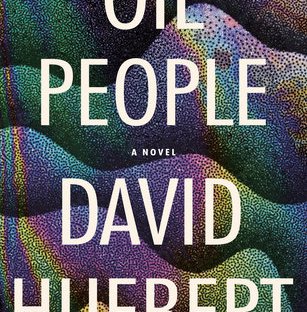

David Huebert’s last story collection was leading up to this novel; Chemical Valley was filled with characters who lived and worked in southern Ontario’s oil country. Oil People takes a closer look at the same area’s history in the oil industry by weaving a tale about a family that spans 125 years. The book alternates between thirteen-year-old Jade in 1987 and her ancestor Clyde in 1862.
“A crow crashed through the canopy and I saw a flash of Clyde through the woods, Replica Clyde, his face almost seeming to nod, and I sensed sudden and bright what he wanted: the slash of metal in my hand. He wanted it and he wanted me and the two of us were beasts in a clearing, plastic and flesh.”
Almost everyone in this book is being haunted by demons. As a boy, Clyde lost his sister on the trip across the ocean to Canada, and has been searching for a version of her in the oil fields ever since: “She would have wanted you to be good, to be a decent man, not a man stooped digging for some tug in the deep, some echo or trace that will never be the thing for which you seek.” Jade’s mother lost her sister in a house fire and suffers from spells of depression. And Jade is able to catch glimpses of Clyde from beyond the veil, although she’s unaware of what exactly she’s seeing. Jade’s friend is fighting the demon of colonialism, while her sister is longing to be free of the legacy of oil: “I felt like the wound of 130 years.” It really does feel as though the oil has been weighing them down all these years. Will they ever be free of it?
“What is perhaps most remarkable about history is not how it shaped the past but how it lives on in the present.”
“The laundry never stopped, never came clean. The water filled with slick, oily shimmer as soon as she dropped a pair of his work trousers in, and then she was washing filth with filth, emptying buckets and boiling more, taking water from the creek, but that too was carrying crude and muskeg, so she melted snow and that turned brown. It was in their skin, their hair, their nails, their faces. In their teeth and the straw of their beds.”

In my review of Chemical Valley, I comment on Huebert’s ability to “nail the atmosphere of the industrial area in which his characters live and work.” The same is true here. And he is so good at making the dreary and grim sound beautiful. This book is full of dirt and mud and worms and miscarriages and sickness and fires and sour marriages, and the parts that take place in 1862 played in my head like a black and white movie, making it all the more dreary. Yet, I have so many notes and bookmarked passages I want to share with you. That’s the magic of David Huebert. I have been hooked since Peninsula Sinking.
“The light changed and the truck hissed through its gears and gasped out a black haze and I began to see the haze again, anew. I saw the green ghosts rising out of the tailpipes all around me, a highway washed in kelp and fronds and flashes of fish scale, silver and red and yellow, the ghosts of tiny fish and mussels and krill crawling out in legions, crabs and saplings, tree plinth and mulch, a huge mixed blender of green and blue and brown, the smell coming on fresh and livid but also burnt, wounded.”
“Love can be a prickly thing. Or it can squirm. It can creep and root underground, or it can crawl, like an earwig, through the canals where voices nestle, secrets bloom.”
In a post on Instagram, I commented that “never has a description of someone with worms been more beautifully rendered.”
A favourite passage: “Lise was sick with practical. She cooked practical. She dissolved the saleratus practical. She kept two heels of water in the wash basin so it wouldn’t rot and she kept the eggs in limewater and she slit the corn husks for the mattresses and melted the tallow and mixed the honey with charcoal and rubbed it on her teeth. Practical. She rationed the beets practical and boiled her May-apple syrup practical, knitted the socks and stitched the rag carpets and mixed the hops with the barm and grafted the apple roots, used mutton tallow and good wick and boiled her sugar beets and tapped the maples and boiled down the sap and fastened the catsup jars with paper dipped in egg white. Practical. She creamed practical, screwed practical, prayed and raged and envied practical. She sat practical in the pews, listening to the Methodist drone about female practicality and the unsung domestic heroines, their good work to tame these wild lands.”
After reading the book, I listened to an interview of David Huebert with Mattea Roach on CBC’s Bookends. Huebert talk about how he became interested in Ontario’s oil industry and that “oil continues to fascinate” him. He talks about petrocolonialism and ongoing land claims. He talks about the ambiguity of the oil industry; the industry provokes strong opinions of good vs. evil and right vs. wrong while people are just trying to live their lives. He hopes his book will induce people to think more intentionally about oil and our relationship with it: “how to be critical while also making space for wonder and joy.”
Further Reading:
Literary Review of Canada: “Oil People is a cautionary tale, but it does not focus on the irreversible damage corporations have done to the planet. Instead, the danger lies in what has been passed down between people. With great nuance, Huebert poses questions about complicity, inheritance, and allegiances. Through no fault of her own, Jade, like her relatives, is simultaneously a witness, victim, and perpetrator. Although she is only on the cusp of young adulthood, will she have time to reckon with the hand she’s been dealt?”
Quill & Quire: ““We’re oil people. It’s in our blood,” Jade’s mother tells her. It’s a woeful fate. As Jade wonders whether she is “simply poisoned, merely mad,” and the St. Clair River births a “gelatinous offspring,” the fallen world around her tumbles further. And Jade – “a green, glowing by-product of the country’s shame, [her] family’s legacy, commerce and greed and territory” – soon comes to experience the brunt of those extraordinary forces.”
 Consumed by Ink
That writing is so vivid and visceral. I can see why you found it so compelling.
Visceral is a good word for it!
I grew up in Oil Country but I didn’t understand it was Oil Country until I was in my early 20s. It sounds as though it was prominent in all these characters’ minds but either I was a super oblivious kid (possible! lol) or it’s also possible to be so much a part of Oil Country that it doesn’t seem like another country anymore. I’ve read his other books, and admire his work.
The family in the book is descended from the early oil pioneers and run the oil industry museum in Oil Springs. They can’t forget that they’re in oil country, even if they try! I imagine, though, if you grew up there, you wouldn’t really think about it.
I’ve never read David H, but it sounds like an author I need to get to know. Where is oil country in Ontario exactly? I’m embarrassed to say I have never heard of it, even though I grew up in Ontario!
His book is set in Oil Springs, Petrolia, and Sarnia. I imagine it would be extra-cool to read this book if you know the area well!
Ohh ok I definitely know the Sarnia area! That makes total sense