
Literary Wives is an on-line book group that examines the meaning and role of wife in different books. Four times a year, we post and discuss a book with this question in mind:
What does this book say about wives or about the experience of being a wife?
Don’t forget to check out the other members of Literary Wives to see what they have to say about the book!
- Kay at What Me Read
- Rebecca at Bookish Beck
- Kate at Books Are My Favourite and Best
- Becky at Aidenvale
Literary Wives welcomes Becky to our group – we’re happy to have her join us!
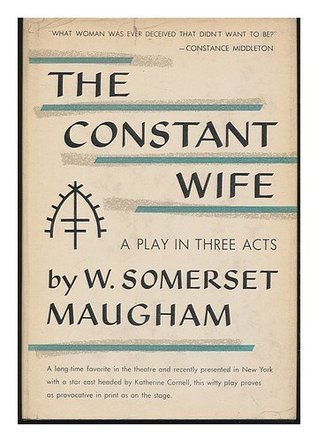
Goodreads synopsis: There is something Constance Middleton’s friends are dying to psst! : her husband is having an affair with her best friend. Despite their hints, Constance remains ever cool, and seemingly oblivious. Or is she? In this comedy of unfaithful manners, Constance (a not-desperate housewife) has surprising ideas of her own about extra-marital activity.
This was a fun departure from the usual for us. I don’t read a lot of plays because I find the stage directions and name cues get in my way, but in this case it was worth it.
Warning: Spoilers ahead!
I was not expecting Constance to be so calculating. At first, I wondered why she seemed so cold and indifferent to the accusations against her husband. Even when his affair was out in the open, she was still as cool as a cucumber.
“I am afraid I must admit that at the first moment I was vexed, but only at the first moment. Then I reflected that it was unreasonable to be angry with John for giving to another something I had no use for. That would be too much like a dog in the manger, and then I was fond enough of John to be willing that he should be happy in his own way…”
Constance’s husband John thinks she’s the greatest, especially after handling the situation so calmly and claiming to be okay with his infidelity. He even goes so far as to promise to never let it happen again, even though she’s not asking him to do anything of the sort. Little does he (or the rest of us) know, she’s planning to use it all to her advantage later. A year after taking up her friend’s offer of becoming business partners, Constance is about to embark on a six week vacation to Italy, apparently on her own. At the last minute, we learn that she’s actually planning to go with Bernard, a suitor of hers from 15 years ago who is still in love with her. John is beyond surprised and starts to refuse to let her go, threatening divorce. Constance takes it all calmly and points out that it is no different than what he had done a year ago. In Constance’s mind, men only have the right to cheat because they are the economic ‘keepers’ of women – women owe them loyalty for being given a home. Therefore, if she is able to become economically independent, she should also be able to demand sexual independence. Not only is she paying for her trip, but she has also paid John for room and board over the last year. This is not at all what he wants or cares about. He’s steaming mad, but she gets away with it anyway.
What does this book say about wives or about the experience of being a wife?
This play was written in the 1920s when societal norms were changing quickly, including ideas and norms around gender roles in a marriage. For far too long, infidelity in men was deemed to be acceptable, but not so for women.
“I am unable to attach any great importance to the philanderings of men. I think it’s their nature. John is a very hard-working surgeon. If he likes to lunch and dine with a pretty woman now and then, I don’t think he’s much to blame.” –Mrs. Culver (Constance’s mother)
“I have my own ideas about marriage. If a man neglects his wife it’s her own fault, and if he’s systematically unfaithful to her, in nine cases out of ten she only has herself to blame.” –Mrs. Culver
“We all know that unchastity has no moral effect on men. They can be perfectly promiscuous and remain upright, industrious, and reliable. It’s quite different with women. It ruins their character.” –Mrs. Culver
When Constance and John first married, they were in love and happy with one another. But after about 5 years, they no longer were, although they still enjoyed each other’s company which Constance remained content with. She considers John a good catch because “he has all the solid qualities that make a man a good husband; an agreeable temper, a sense of humour, and an entire indifference to petty extravagance.”
She could find no fault in her husband’s actions when he took up with another woman, because Constance felt she was no longer able to give him the love he desired. But when Bernard showed up after being away for many years, Constance wanted the same freedom for herself. As long as she was free to pursue her own desires as her husband did, she was content in her marriage. Once she became financially independent, she felt free to do this.
“My dear, there is only one freedom that is really important, and that is economic freedom. Well, I have it and upon my soul, it’s the most enjoyable sensation I can remember since I ate my first strawberry ice.”
Constance has low expectations of men and a practical way of looking at marriage. She feels men are like “little boys” and helpless, “just like dogs.” She thinks they are “sweet” but that it’s “absurd to take them seriously.” And she tells Bernard that she thinks that wives are “no more than the mistress of the man whose desire she has taken advantage of to insist on a legal ceremony that will prevent him from discarding her when his desire has ceased.”
“I can never see why a woman should give up a comfortable home, a considerable part of her income and the advantage of having a man about, because he has been unfaithful to her. She’s merely cutting off her nose to spite her face.”

Join us in September for Novel About My Wife by Emily Perkins!
 Consumed by Ink
Hmm, I didn’t see Constance as cold and calculating, but she is obviously making the point that if her husband isn’t supporting her anymore, she has the same rights as he does.
Near the beginning of the play, the answers she gives to her family’s questions and concerns seemed cold to me. It seemed odd that she didn’t care at all that her husband was being accused of infidelity. But, in hindsight, she seems more practical than cold, it’s true!
I think at the beginning she was pretending. She didn’t want to have to acknowledge his infidelity, because that would mean she would have to do something about it. Which she did!
I thought it was quite a clever trick she played on him! I wouldn’t want to get on her bad side.
Haha! True!
What a curious choice for your group, but it does sound like the kind of story that would leave plenty of room for discussion / debate? I’m skip-reading, to avoid the bigger spoilers, but it seems like that. Just the other day I was looking for more books by a certain author and discovered just how many there are…far more than I expected…but almost all of them were plays when I looked at each one. (Now I just have to remember who it was…but nobody I could read locally from the library, that much I do remember! heheh)
I think it is the first play we’ve read. But it suited our topic nicely. And it was entertaining!
Let me know when you’ve remembered the name of the author! 🙂
It’s the first play I recall seeing in the line-up. Nice for a change, and as well as being a quick and funny read it definitely brought up a lot of discussion points.
For a theatre buff, I suppose it would be interesting, too, to look into when/how the play was produced…various stars in certain roles etc. For your purposes, who was the “Best Wife”?
I really enjoyed this as a pick for the book group.
You make an interesting point about the twenties being a period of changing expectations – I imagine that Constance was slightly ‘ahead of the curve’ given the length of her marriage.
I saw the attitudes of Constance and Mrs Culver as armour against the position they are in as women. Even if it’s subconsciously. I wouldn’t have thought of her as cold, but I do think that she was calculating – not in a cruel way – but she has bided her time in telling people and her husband that she knows so that she is in the best position to know what she wants and claim it.
“Armour against the position they are in as women” is a good way of putting it!
I have often (mostly fruitlessly) argued that our ideas about earlier periods are clouded by the extreme conservatism of the 1950s when we or our parents grew up. In fact the theme of this play, as you have outlined it, is continuous with the ideas of the New Woman movement and first wave feminism of the 1890s and early 1900s. I’m just astonished it was written by Maugham, not that I have ever read him.
I was surprised about that, too. I looked him up to see what I could learn about him quickly – he was smart and he traveled the world. Being a gay man back then, too, he might have identified with other oppressed groups of people, like women.
Constance never says or thinks what you expect her to, which is what made this work! Good point of Bill’s about the New Woman (part of the topic of my MA thesis, though I looked more at religion than marriage).
I love that your club chose a play rather than a typical book – way to read outside your comfort zone! This sounds like it would have a bunch of interesting avenues for discussion too…
It was a fun change and a great choice!