
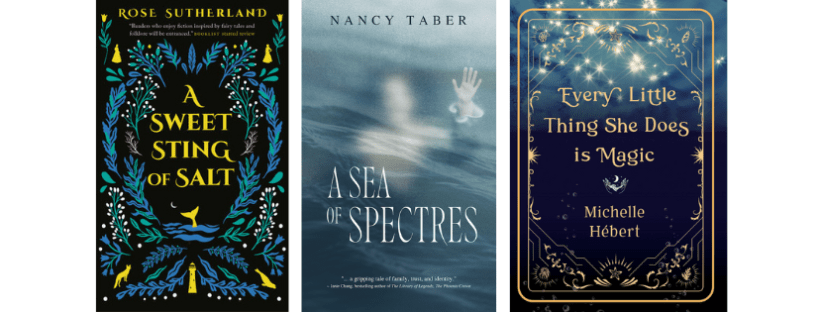
It was mostly a coincidence that I read three new novels within a month that are set in the Maritimes and involve the supernatural. A most satisfying and happy coincidence.

I started with Rose Sutherland’s A Sweet Sting of Salt, which I read for my Real Life book club. Historical fiction, set on the south shore of Nova Scotia, A Sweet Sting of Salt is marketed as a queer reimagining of The Selkie Wife.
I could smell the salt in the air as I read this book. It’s 1832 and a young woman named Jean lives alone by the ocean in the house she recently shared with her late father. Sometimes she feels lonely, but she’s kept busy with her goats, her chores, and her livelihood as the village midwife. She’s not interested in men or marrying, so midwifery is a good option for her. Her reputation was almost ruined when she and her girlfriend were seen sharing a kiss. Her friend was immediately married off and sent away, while Jean’s reputation was sullied by rumours. Luckily, she’s good at what she does and word spread quickly that she could be trusted as a midwife.
Everything changes for Jean when Muirin turns up at Jean’s cottage in labour with her first child. Jean suspects that Muirin must be the new wife of her closest neighbour Toby. Muirin doesn’t speak English, and Jean assumes she is a Gaelic-speaking member of the Scot settlement down the shore. After staying with Jean for a week where she learns a little English, Muirin goes back to Toby, but neither she nor Jean are happy about it. Jean wonders if Muirin is content with Toby and starts sticking her nose in where some would say it doesn’t belong.
“Funny how the sea could do that, wear off all of a thing’s too-sharp edges. Jean wondered how long she would have to be rolled about in the waves to smooth out her own.”
Woven throughout the book are superstitions and the role they play in everyday life. For example, after baking a loaf of bread, “Ida would run a knife ’round the finished loaf and lift it out, rather than turning over the pan and risk turning a ship over with it.” This, along with the historical setting, allows the folktale elements to fit right in.
“Farmers all, they were set down on a land so full of trees and rocks that they were forced into working the seas and the forests instead. Only their mingled superstitions took root, and those had twined around one another until it was hard to say where one story left off and the next began, which were fanciful and which were true.”
The story moves at a good pace and the suspense kept me turning the pages. I can still picture the seals hanging around off-shore, watching Jean and Muirin anxiously, hopefully.

Next, I read A Sea of Spectres by Nancy Taber (Acorn Press). A completely different story altogether at first glance; a contemporary mystery starring a detective working against smugglers and traffickers on Prince Edward Island. Once I thought about it, though, I realized how many similarities there were to Sutherland’s book. They are both maritime stories with a focus on folklore and a primarily female cast of characters. (Not to mention the presence in both books of a burning ship offshore. Although, in A Sea of Spectres, the burning ship plays a much larger role.)
Raina is a descendent of a long line of Doiron women who have supernatural abilities. In the past, these abilities have been used to protect Doiron women and their families, but not without many challenges. Raina has spent her “entire adult life pushing this strangeness away” but now she needs to learn how to use her own abilities in a way that keeps her safe from the phantom ship’s magnetic pull on her, and to whom others have lost their lives. The pull of the ship is so strong when she’s close to her home in Rustico that Raina needs to handcuff herself to her bed at night to prevent being lured into the sea.
“… the peril lay… in the call of the ocean as it lured her towards its mysteries, legends, and shimmering, treacherous beauty.”
Raina is finally roped into trying to figure this thing out when a younger cousin shows up with a journal she stole from the archives. This is Celeste’s journal from 1864, in which she tells both her own story and that of Madeleine from 1758. Celeste’s and Madeleine’s stories are as much a part of this book as Raina’s, and just as compelling. Madeleine and her family were one of the Acadian families deported from PEI by ship to France in 1758, and Celeste was in Charlottetown during the summer of the Charlottetown Conference – the first of many meetings that set Confederation in motion.
How are their stories connected and how can their stories help Raina now?

Lastly, I read Every Little Thing is Magic by Michelle Hébert (Nimbus Publishing). As one of Nimbus’s most recent releases, I knew I wanted to read this before I knew anything about it. It wasn’t until after reading the first two books that I realized this one was also categorized as fantasy. Again, a predominantly female cast of characters, and this time, a ghost. (Although there is no burning ship in this one, the ocean plays a big part in the story, as it does in the first two books.)
The women in Kitten’s family are known to be cursed, and the men in her father’s family carry the burden of the “Love Heart,” which means they die of a fatal heart attack before the age of 48. It does not matter whether you believe these to be true – they are so baked into this family and who they are that it’s almost impossible to get away from it.
Kitten’s mother Queena hasn’t been the same since her sister Nerida died a month before Kitten was born. Queena’s grief deepens over the years and she becomes anxious and depressed for most of Kitty’s life.
“Queena holds court from the only comfortable chair in the kitchen and rules over her small dominion with an armada of denial, manipulation, and disappointed sighs.”
When Kitten was young, she decided magic was the only way to save her family from the curse and her father from the Love Heart. So, she taught herself the art of Tarot as well as spells and potions. Despite this, Kitten’s dad succumbed to the Love Heart anyway, breaking all their hearts.
As much as Kitten’s brother Thom says he doesn’t believe in the Love Heart, his actions prove otherwise. After his wife left him a year ago, he’s been sitting around on Queena’s couch every day since, feeling sorry for himself.
“He’d been licking his pain like a Tootsie Pop for over a year, and he still hadn’t come close to the centre.”
Kitten and Thom have the kind of relationship that seems nasty on the surface, but has an undercurrent of affection; bonded by their family’s curses and their mother’s mental illness.
“”You look like shit,” Thom said. He was wearing a pair of sweatpants with the crotch torn out and an Expos shirt with holes under the arms. At least I’d put on a fresh pair of pajamas.”
Kitten herself has just arrived home after being away with her fiance Matt in British Columbia where everything had been wonderful. Until it wasn’t. She had fallen in love and thought she had gotten away from her cursed family, but now she was back with her newborn baby Pixie. Ironically, Kitten’s vow to keep her baby safe isn’t too far off from Queena’s plan to do the same for her own children after Nerida’s death. But her over-protectiveness took things too far and Kitten has grown up feeling conflicted between loving her mother and feeling smothered and resentful of her.
Aunt Bunny is the person who has been holding this family together over the years. She tried to get away from her own disappointments, but came back to help out after the death of Queena’s husband. Like every character in this book–including a few that I haven’t even mentioned–Bunny has her own story that eventually comes to light as everyone else’s does.
The narrative of the story alternates between the present and the past, allowing the reader to slowly put the whole picture together. It’s a mystery as to what happened between Kitten and Matt. Kitten spends her days sleeping and her nights drinking Rockaberry coolers that she finds in her mother’s bomb shelter in the basement.
Let’s not forget about the book’s ghost, Queena’s long-dead sister, frozen forever at the age of seventeen, her room still in exactly the same condition as the day she died. Kitten is not aware of it, but Nerida tries to help her the best she can for a dead person. She leaves clues in the form of Tarot cards in Kitten’s room, freaking Kitty out at the same time as prompting her to pay attention.
“When I first came to this side, I worried it would be horrible to hear what people said about me. I didn’t realize that the horrible thing is when they stop talking about you.”
With the help of Nerida, Aunt Bunny and a few friends, Kitten starts to pull herself together and come back to the land of the living. Only to find there is a lot more work to be done.
“As Bunny closed the door behind her, a moth flew into the bug light with a spectacular prolonged sizzle. I feared I was headed for a similar fate.”
I can’t write about this book without mentioning that each chapter’s title is the title of a song from the 60s, 70s, or 80s. And they fit in so well with what is happening in the novel. I had songs I hadn’t heard in years running through my head for weeks after reading this book. It adds some fun to a book that otherwise deals with some heavy subject matter like death and mental illness.

I can’t wait to see what these authors write next!
 Consumed by Ink
The first and third novels both appeal to me! I hope I can come across them down here.
And their covers are so pretty! 🙂
I think I’ve mentioned that I keep getting these covers (on the first and third books) confused (and Henstra’s new book this year is similar too). Am I misremembering: didn’t the sign of a ghost character used to send you running in the opposite direction? In an overdone-trope way, not a scared-way? But, maybe both? lol Either way, I think a good ghost can make a story very entertaining. I also like the idea of books set in PEI (and books that take on trafficking and black market stuff, regardless of where they’re set) although I don’t think I’m in quite the right mood for any of these right at this moment. There are song titles in Indian Summer too (I think you read that one? or, else, you were thinking of it?) and I really loved that.
I haven’t read Indian Summer. And I’m not even going to look it up right now – I don’t want to know how much I’d like it! Lol
There are too few books set in PEI, even when you’re looking for them! There’s not a lot about trafficking in it, though… that’s her job, but she’s too occupied with other matters for most of the book.
Yes, Henstra’s new book! I knew there was another Tarot book! You know, there’s also been a significant uptick in tarot card books going out at the library the last couple of years.
True – I usually think I won’t like a ghost in the story, but then I usually do. 🙂
I recently read A SWEET STING OF SALT – lovely story. Reminded me of Hannah Kent’s works but I liked that the ending wasn’t too gloomy. I’ll also be keeping an eye out for more from Sutherland. 🙂
In my mind, the whole story is a dark blue/grey colour like a stormy sea. But, you’re right, the ending could have been very gloomy – instead it tended more toward the blue than the grey. 🙂
I really like the sound of the Rose Sutherland novel. Your description reminds me of Kiran Millwood Hargrave’s books (e.g., The Mercies) — do you know those? You know how I love finding these thematic connections and shared elements!
I haven’t read The Mercies, but I just read about it and it totally does sound similar. Now I want to read it!