
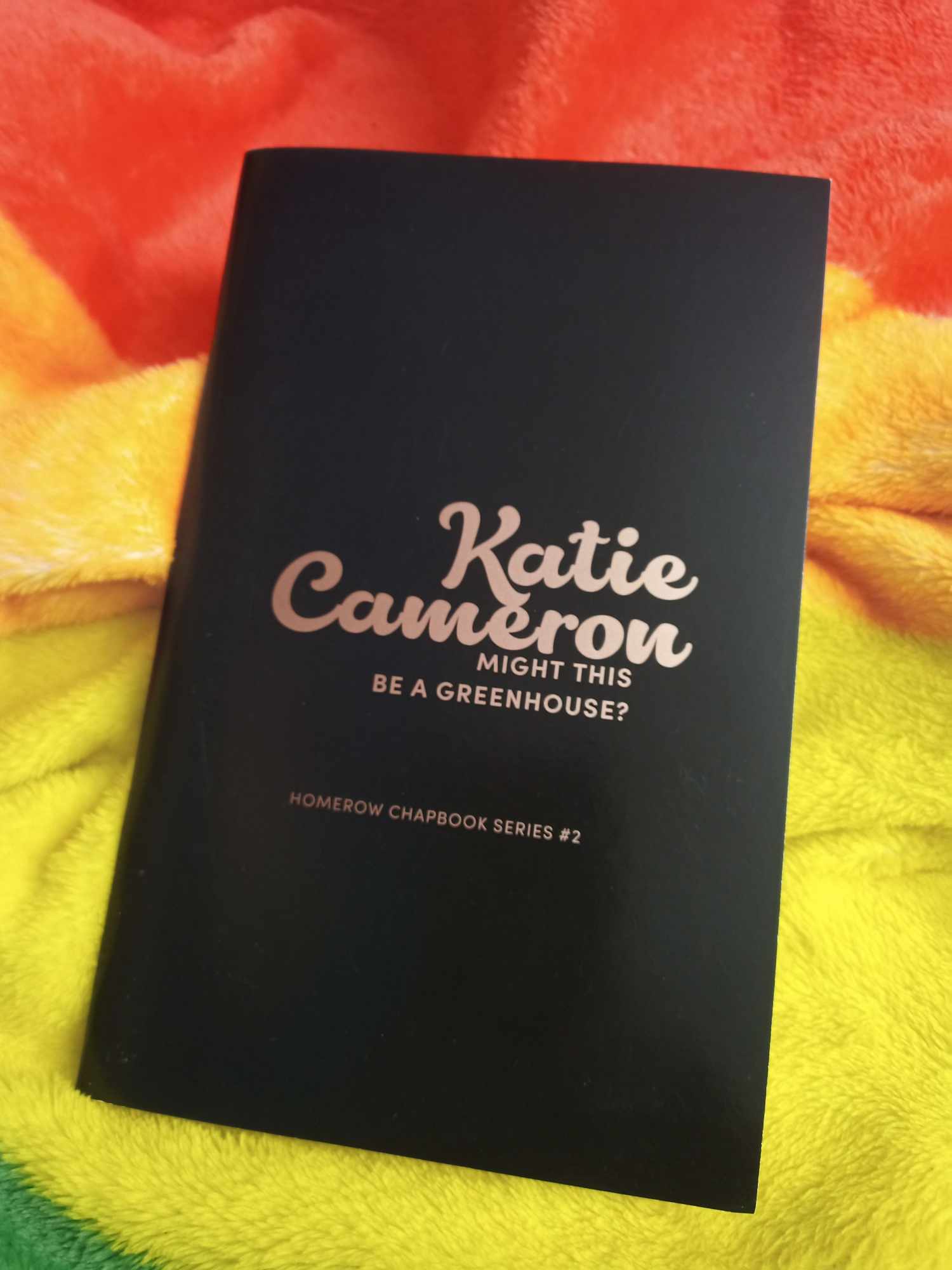
Might This Be A Greenhouse? by Katie Cameron
Katie Cameron’s chapbook is #2 in a series of chapbooks being published by Qwerty Magazine at the University of New Brunswick in Fredericton.
The joy in reading Katie’s chapbook begins with the table of contents. Titles like “Mom Asks Me When My Anxiety Started,” “I Could Never Hate Grapenut Ice Cream,” and “The Kids Next Door Play Outside Again” delight me and make me think I am going to be able to relate to these poems despite the two decade age gap between myself and the author. There are familiar themes and scenarios in the journey Katie takes from grade 9, through university, until the present. You don’t need to have experienced the same journey as Katie to find keen insight and familiarity in her words.
I love the analogy in “Mom Asks Me When My Anxiety Started” of legs pumping on a swing, desperately trying to be in sync with her friend, “like two swings in synchrony means ‘married’,” but finding she is “always just a little off.”
A sense of queerness makes itself known: “panging in my stomach as I see two girls dance” and “On my nightstand, a library copy of Dionne Brand poetry, / from the queer resource centre, a book of comics, / a graphic novel.” Then, an Ace identity insinuates itself: “I tell a therapist never have I ever and don’t know that I’ll ever.” But, at first, there’s a sense of brokenness: “I shake my head / at this broken / machine.”
Insomnia: “streetlights were glasses of beer / sloshing. Low chatter crackled / like two radio stations, each cutting / in and out. Taxis droned, racing / the flashing traffic light. I’m a traffic light / stuck on green.”
Anxiety and depression: “Some days, I’m stuck / underground, soil in my ears, nose and mouth. / Try to dig myself out.”
Carefully chosen words that evoke vivid images in my mind. Like in this poem about ear wax: “You’re full of pops and crackles, / itches to be tugged, pain / to press away.” And this one, about dull knives: “The chef’s knife got stuck, its blade / the hull of a sinking ship–I wrench the wheel / back and forth. The sweet potato bouncing / onto the floor.”
As a co-worker and fellow Queer Book Club member, I might be biased about Katie’s talent… but I don’t think so. I have no doubt Katie’s writing is special and that her career and success will only continue from here. I can’t wait to read whatever’s next!
Katie’s chapbook is sold out. If you’re interested, you can purchase the digital chapbook here.
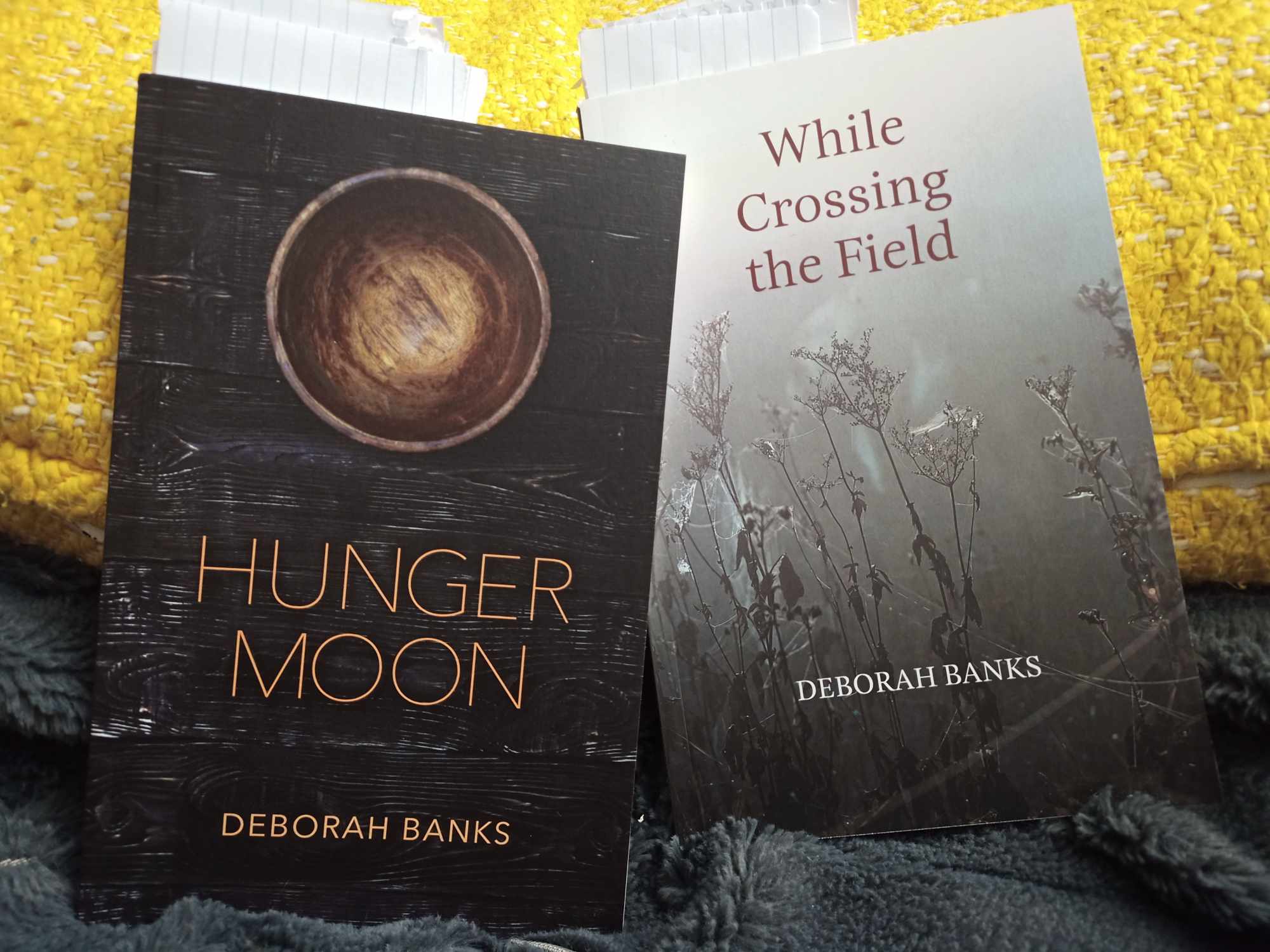
While Crossing the Field by Deborah Banks (2020)
Deborah Banks lives in Sherbrook, NS and her poetry books are published by Pottersfield Press. While Katie Cameron’s poems are a coming-of-age journey, Deborah Banks’s poems are of the natural world.
While Crossing the Field explores the natural world surrounding the author’s home from spring to the following winter. Inspired by what she sees around her, Deborah’s poems touch on landscape, animals, and inner reflections. Standing outside, going for walks, or looking out her kitchen window, Deborah watches the changing seasons and everything they bring or leave behind.
Deborah lives in the moment, loving it all as it happens. Every moment is best, until the next moment is.
“The long thunder of the ocean / is rolling along the shore. / I can think, in some moments, / it is all I ever wanted. // But then I remember the musky smell / of the woods today, / the trail mossy and tempted by spring, / and I might think: This is enough. // Both equals. // And then the stars tonight / breaking their familiar canvas / with light. // Well, it could be that.”
Among my favourites are the animal poems. The crow who “returns with his entourage / and they are excavating the compost / then crossing the mowed lawn / like old bowlegged men.” And the bees “tentative, a few scattered in the garden / almost haphazard in the humid air.” A spider has spent its summer in Deborah’s kitchen, watching her: “this small black bead has watched me / from the corner / where the shelf meets the wall / and all summer, at my hand: clemency.” I too love spiders in my house and worry that there won’t be enough for them to eat. I also love the morning dew on their webs outside: “This morning the fog is lifting / and the spiders have shot wires / of stringed light / across the yard.”
A favourite line: “My words are looking for a place to be / and they won’t settle.”
Hunger Moon by Deborah Banks (2022)
Hunger Moon offers more poems inspired by nature, but they speak more to community and connection than the previous collection; more specifically, the need for community and connection in the face of a pandemic.
“I am trying to find ways to chronicle / the earth’s story / to invite the land and skies to speak / to stir up your emotions / to hope and generosity / that you can rise in the morning / look out your window / and find just one thing that the earth is narrating… Nobody is excluded. / You can have this.”
Deborah speaks of the deer “keeping quiet company,” Cindy’s hot pepper jelly as a “thing of beauty” when held up to the “January light,” and the “new aliveness” of spring. She admires the slug in her greenhouse, “his long caramel body / working its way up the leaf.” She studies the bees who are “shaking the flowering oregano / with their striving and pulsing,” pauses to “press the jewelweed / into our palms and watch the seeds explode,” and enjoys the “cool relief of the sea” on a hot day.
She revels in her rural community: “from the smallest life on the barn wall / to human endeavor in the field,” a phone call from her mother in Quebec “to tell me to look at the moon,” a garden chat with a neighbour as they “meet over the parsnips.” Deborah and her neighbours leave “unasked for gifts of bounty” in each other’s mailboxes, and she feels sustained by the gifts of her garden, “the soft tomato skins bursting / in boiled water, / fresh garlic from the garden / and the parsley and basil too, / each humming with aroma.”
She reflects on doubt: “We build monuments to it / and carve our decisions with it” and wonders if plants and animals ever feel the same: “Do you think the trees believe / in the soil beneath their feet… The plump robins in the grass / do they doubt the worm?… What about the creeping starfish / and the sand dollars along the shore? / As they wrinkle the sand / with their cloistered movements…” And she reflects on the healing and saving grace of nature: “But this: coming home tonight / I see the loon pair drifting on the water. / Do you understand how this rescues me? / How I pull it from the pocket of my life / and revisit it, just now / and I am redeemed briefly…”
“It is enough: / to be here / to be small and insubstantial / to turn out the lights / and climb the stairs.”
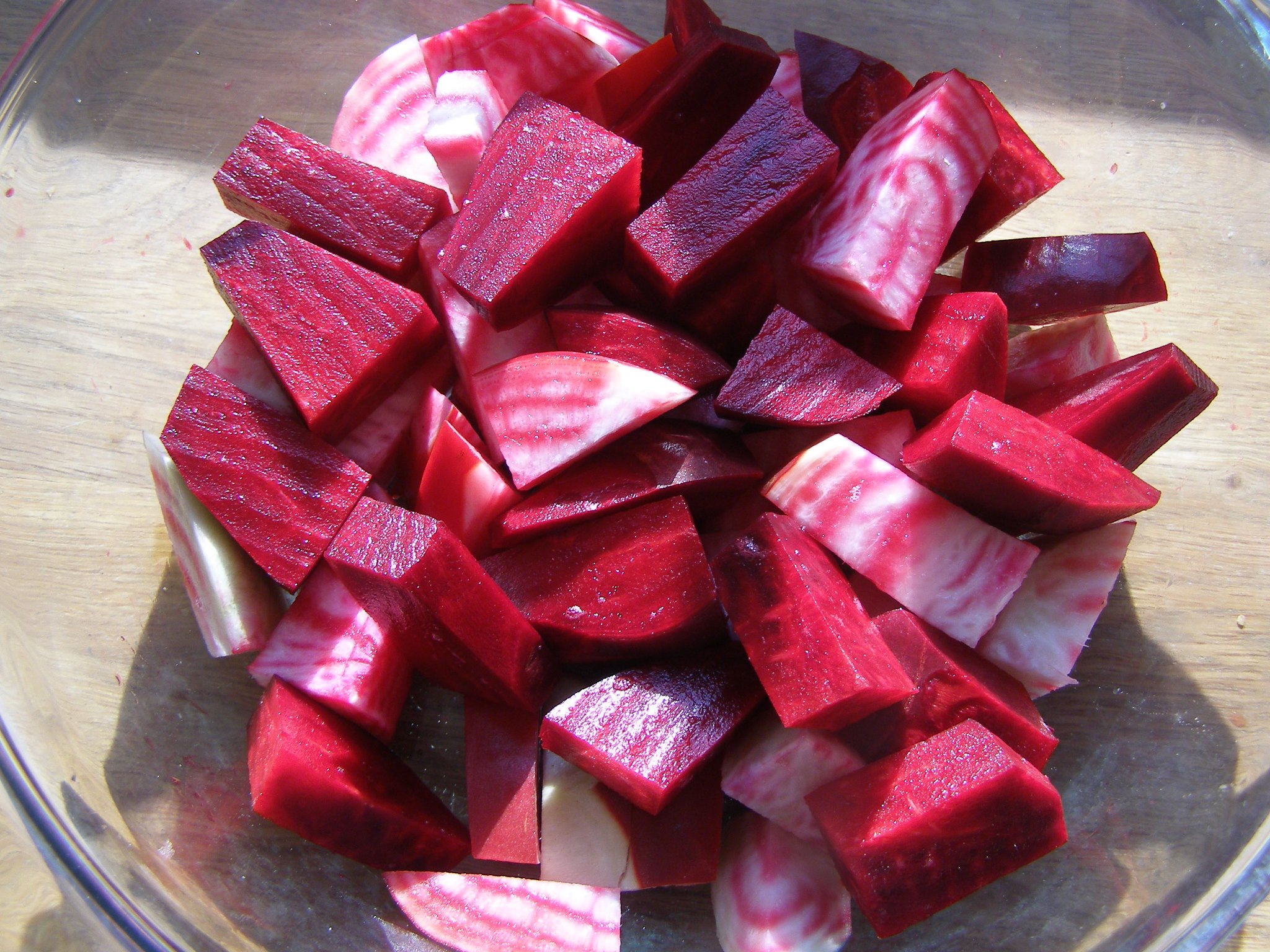
I love this poem about beets:
“Consider the earthiness of raw beets from the garden. / From the damp soil that cupped them, / to the blood red dye / that sets trails into my creased hands / where rivers of stories unspool under my nails. / Those bold collectors of light / have given me the rings of Saturn / in their open hearts.”
Have you been reading any poetry lately? What kind of poetry do you like to read?
 Consumed by Ink
I love that you did a post for Poetry Month! I don’t think of you as reading it very often? I’d enjoy any of these: nature poetry always draws me, and I love verse as a way of telling a life story, too. Also, I want to know more about your Queer Book Club!
You’re right – I’ don’t read a lot of poetry… It usually gets buried underneath all the fiction. But I do read some, even if I don’t always write about it.
The Queer Book Club I’m in is my only ‘Real Life’ book club. We read and talk about books written by queer authors. There’s a core group of about 5 of us – small but mighty! Our book this month is Our Wives Under the Sea, which I think you’ve read!
That’s awesome! Did you say it’s all colleagues? I loved Our Wives under the Sea. I wish my book club was more adventurous with its selections.
Three of us work together at the library. I feel really lucky – our group seems keen to try lots of interesting books!
The quotes and lines you’ve pulled from these books are like rationed nibbles of the best cheeses. The crows: “then crossing the mowed lawn / like old bowlegged men.”
Admittedly, I don’t reach for poetry but I’ve always been attracted to chapbooks and this post is a convincing one about the strength found in brevity!
Thanks, Jules! I’m the same way with poetry, but when I do read it, I almost always enjoy it!
That is such a gorgeous picture of the beets in the bowl! Well done.
The lines you pulled from these collections are beautiful, I love the nature ones but the coming-of-age collection looks FUN!
I love beets. I like how they taste, but they’re also so pretty!
I feel like you’d have to be some kind of grinch not to like nature poems. Lol
I can see why you would have enjoyed these. And I love finding beet references in poems and stories!
This year I’m searching out Indigenous poetry in particular. The library has quite a few and most of them are new-to-me, so I read a couple poems from them every couple days, just casually.
Does your library have shalan joudry? I love her poems!
Well all three of these collections sound great. I’m particularly attracted to poems that feature nature.
I find that nature poetry lends itself well to reading one or two a day so you can really soak it in. 🙂