

Literary Wives is an on-line book group that examines the meaning and role of wife in different books. Four times a year, we post and discuss a book with this question in mind:
What does this book say about wives or about the experience of being a wife?
Don’t forget to check out the other members of Literary Wives to see what they have to say about the book!
- Kay at What Me Read
- Rebecca at Bookish Beck
- Kate at Books Are My Favourite and Best
- Becky at Aidenvale
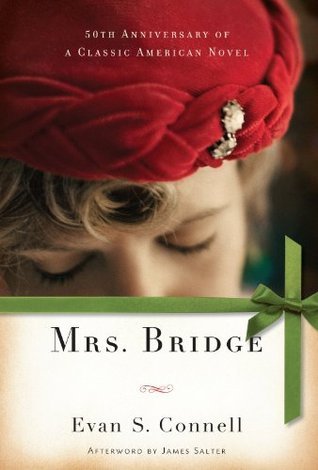
Goodreads synopsis: The wife of a successful lawyer in 1930s Kansas City tries to cope with her dissatisfaction with an easy, though empty, life. India Bridge, the title character, has three children and a meticulous workaholic husband. She defends her dainty, untouched guest towels from son Douglas, who has the gall to dry his hands on one, and earnestly attempts to control her daughters with pronouncements such as “Now see here, young lady … in the morning one doesn’t wear earrings that dangle.” Though her life is increasingly filled with leisure and plenty, she can’t shuffle off vague feelings of dissatisfaction, confusion, and futility.
Warning: Spoilers ahead!
First, I’m struck by the fact that Evan O’Connell–a man–published this novel at the age of 35. He must have been a keen observer of the world in which he grew up. I wonder if his parents knew they were so transparent?
Overall, I found Mrs. Bridge to be a sad read. There is humour in it, for sure, but I felt so sad for Mrs. Bridge at the end of the book when all she wanted to do was live in the past; she felt like her whole life’s worth was taking care of her husband and children. And I feel sad for every woman out there that felt that way or that is still feeling that way.
It was interesting to read about her relationship with each of her children and how they were all so different. Mrs. Bridge seemed passive in everything she did, including raising her children. She really doesn’t seem to know why they all turned out the way they did, and she doesn’t seem to know them. She looks back fondly on the bustle of raising young children, but I don’t think that–as it was happening–she was really very present. She mentions a couple times that she almost wishes Harriet away so she could feel more useful. I wonder what her life might have been like if Harriet hadn’t been there?
I felt angry at Mr. Bridge for his stereotypical fatherly course of action: work a lot to make lots of money to “take care” of the family, when really they just wanted to to spend more time with him. If they had told him that, would he have listened? Or is that the excuse of men who don’t want to bother helping in the home? I was happy to read about the Bridges on their trip; without that section, there would have been no way of knowing if there was any affection between them. The fact that there seemed to be some almost isn’t enough to make up for the fact that the moments and show of affection seem to be very infrequent.
The scene in which Mrs. Bridge got out her old recipes and decided to make something special for Mr. Bridge like she used to was heartbreaking.
Appearances are all-important to the Bridges. Any kind of issue with the kids is swept under the rug, resulting in the gulf created between her and her children. When she implores Carolyn to try to get along with the husband who has just assaulted her, Carolyn says, “no man is going to push me around the way Daddy pushes you around.”
I was disturbed by the racism in the book – but it was the 1930s. Be aware that it’s there.
What does this book say about wives or about the experience of being a wife?
Many of the wives in this book–mostly Mrs. Bridge’s friends–seem to have the same experience as Mrs. Bridge: they’re left to run the house while their husbands work. As their kids grow, they feel less and less relevant. Some of her friends were as bored as she was, and one even commits suicide. Obviously, money doesn’t lead to contentment in life or marriage.
Mrs. Bridge started off feeling excited about her future with Mr. Bridge, but ended up disappointed and dissatisfied. Worse, she was often bored and wondered what the point was of her life. In addition, because her husband was away a lot and distant when he was home, she didn’t get the affirmation of love from him that she craved. There are moments that indicate that he does, but it’s not enough.
Partly because its the 1930s, she relies on her husband to guide her, wiping out her ability to trust herself. Mr. Bridge isn’t unkind, but he does seem to consider himself her keeper. Again, he showers her with expensive presents when really all she wants is his time.
I feel as though Mrs. Bridge was so focused on her role as wife and mother for so long that she lost who she was as a person. Not only that, but she didn’t seem to have a lot of self-awareness; she seemed to be almost puzzled at the end about her feelings of uselessness and invisibility, like she didn’t know how it could have happened. And I wasn’t left feeling hopeful that she would get it back; instead, I was left with the feeling that she is just waiting out the rest of her life, just like she is left waiting, at the end of the book, for someone to come along and help her out of her car.
“She spent a great deal of time staring into space, oppressed by the sense that she was waiting. But waiting for what? She did not know. Surely someone would call, someone must be needing her. Yet each day proceeded like the one before. Nothing intense, nothing desperate, ever happened. Time did not move. The home, the city, the nation, and life itself were eternal; still she had a foreboding that one day, without warning and without pity, all the dear, important things would be destroyed. So it was that her thoughts now and then turned deviously deeper, spiraling down and down in search of the final recess, of life more immutable than the life she had bequeathed in the birth of her children.”
Next week we have a new LW member joining us from Germany. Welcome to Marianne of Let’s Read!
Join us in June for Interpreter of Maladies by Jhumpa Lahiri!
 Consumed by Ink
About your very first comment. I just thought about that today. I was wondering if he was trying to imagine what it was like to be his mother, since he published it in the late 50s. And maybe with Mr. Bridge, he is trying to figure out his father. I guess that’s what you thought, too.
As to your comment about Mr. Bridge, I grew up 20 years later, but I remember that very common idea, that it was the man’s job to provide, and that whatever the work required, he would do. And this came from the employer as well as the employee. This was very, very common. No one talked about work/homelife balance back then. We wanted our dad home more, too, but he traveled all over the world for work and could be gone for weeks on end. If we had said we wanted to see more of him, I’m sure that, although he was very family-oriented when he was home (much more so than Mr. Bridge), he would have said he couldn’t stay home more. This way of looking at things was very common until about the 70s or 80s. I guess what I’m trying to say is it may be stereotypical, but it seemed, at least in suburban U. S., to be a common way of life.
The other thing was, I grew up in a big suburb to a smallish town, lots and lots of houses with kids, and I only remember one working mother, and she was a schoolteacher. (Of course, most of my elementary teachers were women, and some of them were married.) I wonder how many of them ended up feeling this way after their kids were gone.
You made lots of insightful comments about the marriage.
The Women’s Room by Marilyn French hit so many chords for me as a girl and woman growing up in the 60s and 70s.
I also immediately wondered what his mother thought of his novel, but then saw that she died before it was published.
I feel sorry for Mr. Bridge, too, constantly working. Now I’d like to read Mr. Bridge to see how he felt about it.
This book did make me wonder about all the other Mrs. Bridges – how many of them escaped feeling irrelevant?
I don’t know. That’s why I mentioned The Women’s Room, which starts out with the woman sitting in a rocking chair staring into space after her kids leave the nest. But then she decides to do something about it. That’s in the 70s, though. In the 50s there would be fewer options and less of an idea that she COULD do something. And also, maybe you get into a rut, as in, when you have children in the house, you probably don’t have a lot of time to pursue your own interests, and then fairly suddenly, they all start to lead their own lives. And you’re not in the habit of pursuing your own interests. Does that make sense? My mother eventually had to work, but I remember her at times sitting at the dining table staring into space for hours. And she actually did pursue some interests as a married mother. She was in amateur theater. So, at least she had something to do some of the time.
That makes perfect sense. Even now, when you’re at home with small children for a long time, you lose all sense of everything else until they get a bit older and small snippets of time come back to you and you’re able to start thinking about yourself again a little bit. That’s what happened to me, anyway. It’s possible that it’s more immersive if you’re a stay-at-home mom like I was for about a long time. And like many women would have been decades ago.
That’s my guess. I never had kids, so you probably know better than I do. But I was watching my mom.
I’ve been skip-reading this post and comments because I haven’t read his books, this one or Mr., but I saw your mention of Marilyn French and ohhhhh, how I absolutely LOVED The Women’s Room (and all of her other books too, except I haven’t yet read the last one, and my favourite remained The Women’s Room throughout).
Hopefully this comment lands this time ’round!
Yes, it did. The Women’s Room contained so many experiences that I had gone through, too, at the time.
That’s a great point, that Connell was young to be making comments about midlife marriage. I’m always impressed when novelists are able to imagine themselves into the experience of someone of a different gender or generation, and I think he’s done that very effectively here.
We focused on one of the same long passages. I’d forgotten about the scene where she tries to make dessert for him. There are so many poignant little moments like that.
I wonder what she’ll do with her post-Mr. Bridge life? Find some freedom and fun, I hope.
I hope so, too, but the ending didn’t seem very hopeful. One of the things that went through my mind was that no one notices her trapped in her car until it’s too late! But a much better ending would be that she eventually gets help and uses her new-found-freedom to do something wild! 🙂