

Literary Wives is an on-line book group that examines the meaning and role of wife in different books. Four times a year, we post and discuss a book with this question in mind:
What does this book say about wives or about the experience of being a wife?
Don’t forget to check out the other members of Literary Wives to see what they have to say about the book!
- Kay at What Me Read
- Lynn at Smoke & Mirrors
- Rebecca at Bookish Beck
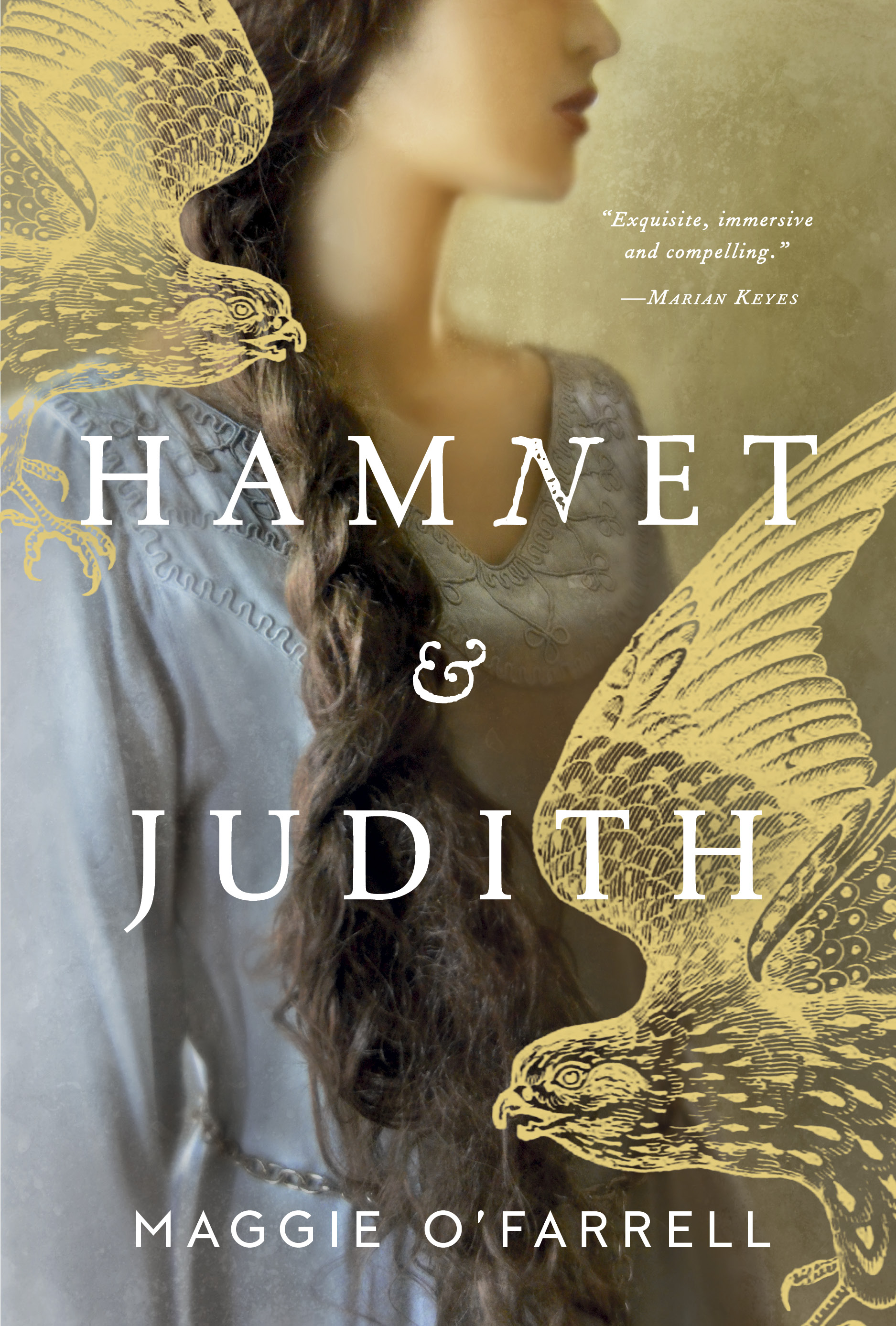
Goodreads synopsis: Warwickshire in the 1580s. Agnes is a woman as feared as she is sought after for her unusual gifts. She settles with her husband in Henley street, Stratford, and has three children: a daughter, Susanna, and then twins, Hamnet and Judith. The boy, Hamnet, dies in 1596, aged eleven. Four years or so later, the husband writes a play called Hamlet. Award-winning author Maggie O’Farrell’s new novel breathes full-blooded life into the story of a loss usually consigned to literary footnotes, and provides an unforgettable vindication of Agnes, a woman intriguingly absent from history.
Warning: Spoilers ahead!
I loved this book. I was surprised by how effortlessly I was swept along until, in what seemed like no time at all, I was done. I had no trouble imagining the sixteenth century world I was in, and was surprised by how relatable it felt. It’s hard to imagine living in a time when it’s so easy to lose your children.
I was sad for her that her son died, but mostly I was angry at her husband–not for leaving–but for staying away for such long periods of time. She saved him from himself and his family, and then he abandoned her to cope with the grief over their son alone. I don’t care that he’s Shakespeare, I’m so angry at him. (I also thought it was clever not to name him as Shakespeare. It made it easier to forget who he was and just look at them as an ordinary sixteenth century English family.)
Almost ordinary, anyway. Agnes has the ability to see what’s inside a person by touching them. Normally this might turn me off a little, but in this case I think it added something special to Agnes’s character, helping to make up for the real Agnes being overshadowed by her husband.
‘You know,’ he mutters, ‘I have never really understood why my sister chose you, above all others. “What do you want to go marrying him for?” I said to her. “What use is he?” Bartholomew takes his crook and places it squarely between his feet. ‘You know what she said to me?’ / The husband, standing straight as a reed now, arms folded, lips pressed together, shakes his head. ‘What did she say?’ / ‘That you had more hidden away inside you than anyone else she’d ever met.’
What does this book say about wives or about the experience of being a wife?
Obviously, the experience of being a wife is very different in Shakespeare’s time than it is now: a wife is subject to as many babies as she can have without it killing her, she’s subject to all the work there is to do around the house, and she’s subject to whatever or however her husband decides to treat her. Happily for Agnes, she loves her husband and the feeling is mutual. However, this does not prevent his bad behaviour, which she suffers from all the more because she loves him.
After being married, Agnes and Will have to live right next door to Will’s family. Because they live so close, Agnes has to find a way to get along with her in-laws whether she wants to or not. Will’s mother does not like her at all, at first, but it seems as though she grows an affection or–at least–a respect for her over time.
Whatever differences Agnes and Mary have – and there are many, of course, living at such close quarters with so much to do, so many children, so many mouths, the meals to cook and the clothes to wash and mend, the men to watch and assess, soothe and guide – dissolve in the face of tasks. The two of them can gripe and prickle and rub each other up the wrong way; they can argue and bicker and sigh; they can throw into the pig-pen food the other has cooked because it is too salted or not milled finely enough or too spiced; they can raise an eyebrow at each other’s darning or stitching or embroidery. In a time such as this, however, they can operate like two hands of the same person.
Agnes sees the toxicity between her husband and his father and schemes to get Will out of there.
She sees how she, Agnes, must remain calm, steady, must make herself bigger, in a way, to keep the house on an even keel, not to allow it to be taken over by this darkness, to square up to it, to shield Susanna from it, to seal off her own cracks, not to let it in.
As a result, Will comes back to himself, but only until the death of their son. At that point, Will starts staying away from Stratford for long periods of time, writing fewer and fewer letters. Agnes is left to grieve on her own. She also lives with the knowledge that her husband is with other women while he is away. I can only hope that things get better for her after the book ends.
Agnes is not the person she used to be. She is utterly changed. She can recall being someone who felt sure of life and what it would hold for her; she had her children, she had her husband, she had her home. She was able to peer into people and see what would befall them. She knew how to help them. Her feet moved over the earth with confidence and grace.
Join us in March for our next book: Mrs. March by Virgina Feito!
 Consumed by Ink
I wasn’t angry at him. I thought he wasn’t able to handle the reminders of his son, even after he wrote Hamlet. There is one remark about how he can’t bear to look at the boy who is playing Hamlet even during rehearsals. I just thought it was his way of handling grief. Before Hamlet died, although he was gone a lot, they said he would come home for a month at a time, whenever he could. It is Agnes who, when she goes to the play, learns to understand his grief. Of course, it’s always the woman who has to understand.
I think, though, that he has the freedom to handle his grief the way he wants to or needs to, while Agnes has to stay at home and face all the reminders of their son without the same freedom. I’m sad for him and feel angry at him at the same time.
The very end did give me some hope that they’d eventually be able to heal.
That’s a good point. And yes, I think that’s what we were supposed to get out of the ending.
Hamnet has been written about a lot, but I haven’t really been driven to read it, though, as with much popular contemporary fiction, I will pick it up if it appears as an audiobook at the library. I don’t particularly like historical fiction, but I accept that it is worthwhile to use a known, old situation to muse about, in this case, marriage. Big families were still common in the country towns I lived in as a child (in the 1950s), though thankfully infant deaths were less so. My wife carried her own grief, and while I stopped going away while the kids were growing up, I don’t think I was much more use to her than if I hadn’t.
That’s an interesting perspective. Thanks for sharing it! Maybe Shakespeare would have just made things worse for Agnes if he had stuck around. A little something, though, can sometimes go a long way.
I have always loved historical fiction – it’s an enjoyable way to learn some history!
I really liked this too Naomi. Thank you to the Literary Wives for the prompt to pick it up! I wasn’t angry at WS – I just found it all so sad. By coincidence I read Rob Delaney’s memoir about the death of his son quite recently too – I recommend it if you can bear it, it’s so raw and loving and angry. A really powerful telling of his bereavement.
I think I’m the only one who was angry at Shakespeare – I’ve been asking myself why that is. It’s not that I don’t feel sad for him – it just bothers me that his grief drives him away while Agnes doesn’t have that same freedom. But I guess there’s a reason why the death of a child can be so disastrous for couples.
I have never heard of Rob Delaney, so thanks for the recommendation – his book is now on my list!
That’s a really good point Naomi – he has the choice to leave, which Agnes could never do.
Enjoy is probably the wrong word, but I hope you like the Rob Delaney – I found it really moving.
Hamnet is one of those books that people just seem to LOVE. I’d love to go back and read is someday, the O’Farrell books that I’ve read I’ve always enjoyed, and she does a fantastic job at researching life back then.
It’s such a good book – I’m glad I got to read it!
I’d forgotten that this had a different title in Canada! I wonder why…
Me too!
I loved this book. My first by O’Farrell but made me go on to read The Marriage Portrait. Which would also be a great selection for the Literary Wives!
Yes, it would be! Thanks!
I love that kind of reading experience you’ve described having with this one (I’ve not read MO’F other than interviews), where you just fall in, and it seems like you’ve barely begun to read when you are nearly at the end. It seems so magical!
Me too! And it gets harder and harder, I find, with all the other distractions.