

The following three books include a short story collection, a novel translated from French, and a novel in verse. Biblioasis books continue to delight me!

Cocktail by Lisa Alward (short stories)
It’s been several months since I read this book, but it was one of the best short story collections I read this year so I’m going to do my best. Fortunately, I have good notes.
The titular story–Cocktail–was a super start to the collection. A woman remembers the parties her parents used to have in the 60s and 70s, and how they changed over the years. She specifically remembers one of the guests, a man who introduces himself to her as ‘Tom Collins’ and has an impact on her for years to come.
The cocktail party would lay at a remove: the grownups put on their party clothes and seemed to forget us. Certainly, David and I knew not to come back downstairs to fetch a glass of water from the kitchen or say we couldn’t sleep, had had a bad dream. Instead, we lay under our covers thinking about the bared shoulders of the women, the stale cigarette smell that clung to the men’s overcoats and listening to their voices: clinking and burbling at first, then swelling, seeming at times to almost rush against the floorboards. The harsh, sudden laughter that meant they were having fun.
In Hawthorne Yellow, a young couple renovating their dream house discover that it’s not the romantic bonding experience they hoped it would be. They pay a man to come work on one of the rooms, and the woman–who is home with a baby– spends her days very aware of his presence.
The truth was that when Alex grazed her palm with the wallpaper scrap, she’d felt not just the dry heat of his fingers and her own surprised pleasure, but also, deep inside, a booming emptiness, like a dryer going through its cycle with nothing but some dishrags or a lone slipper.
A young mother meets a new friend at a Thursday morning playgroup. Maeve turns out to be preachy, regaling the other mothers with her breast-feeding stories and the benefits of co-sleeping.
Still, the hours I spent there, downing cup after cup of acrid filter coffee, cutting out paper shapes of rainbows and fishes and daisy petals with gluey scissors were, in truth, the highlight of my week. Thursday-morning playgroup was Joshua’s and my one engagement: a clear circle of breath in all the steamy formlessness.
In Bundle of Joy, Joe and Ruth travel to visit their first grandson, but Ruth can’t seem to do anything right.
It wasn’t supposed to be like this. Why have all the nice things she’s ever done just floated off, leaving only this ugly mess of unintended cruelties?
In Orlando, 1974, a man decides to take his family of five to Disney World. His enthusiasm is dashed by all the vomiting and the displeasure radiating from his wife. In Wise Men Say, a woman can’t stop thinking about a summer romance she had over 30 years ago. Pomegranate tells the story of a group of grade 8 girls behaving badly. (So badly, it was hard to read that one.) A woman reports a break-in in her house in How the Smoke Gets in Your Eyes. And in Little Girl Lost, a woman thinks back on the little girl she met when she was 20 years old – the daughter of a drunken artist.
All are good, solid stories. Highly enjoyable.
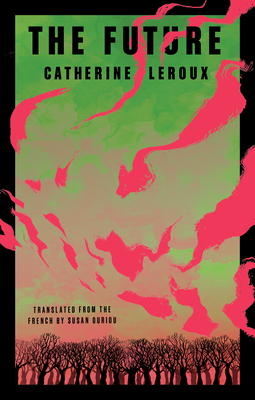
The Future by Catherine Leroux
The Future is set in an alternate future of our planet in which the city of Detroit was never surrendered by the French and has been decimated by pollution, poverty, and substance abuse. Gloria arrives in search of her granddaughters who went missing after the death of their mother.
“Ten days after Gloria’s arrival, her neighbour is killed on the street.” This is how the story begins. Gloria has been living in her daughter’s derelict house with only a mouse for company, but after the tragedy next door, she becomes friends with Eunice, the daughter of the man who was killed. Despite the fact that Eunice is the younger of the two, she takes Gloria under her wing, warns her of the dangers (suggests she gets herself a weapon) and introduces her to the “good eggs” of the neighbourhood.
She thinks of all the stories she has heard of Fort Detroit and all those she has yet to hear. Once attention is paid, one tale follows another like scarves from a magician’s sleeve. The city of revolts, bankruptcies, injustices, and stray bullets, the city of curses, pyromaniacs, and poltergeists. Gloria presses hard against the glass as though to keep every one of them out.
What Gloria’s really come for, however, is to find her granddaughters, who she hasn’t seen in ten years. The more she questions her new neighbours, the more stories she hears about their neglect. Gloria knew there were problems with her daughter but hadn’t known things had gotten so bad. Finally, Gloria decides to head into the park to see if she can find the children who are rumoured to live there. Maybe they’ll know something about her granddaughters.
At this point in the book, the narrative starts alternating between Gloria and the orphaned children. The children have a whole system set up for survival in the park. Each child has a role to play, whether it be gathering food, village security, or leadership. (One little boy is in charge of the books and is considered to have all the answers.)
Farther along, a mini, a boy, cries from exhaustion as does an older girl with a nosebleed—a rule of thumb in the Ravine is that there are always one or two children crying, two or three laughing and fighting, half a dozen who are sleeping, a few emptying their intestines after having ingested unripe fruit or stagnant water, and one caught up in the throes of death. Their lives are short and magical, hard and full, and all are governed by Fiji.
We get a sense of how these children think and behave in reaction to their individual experiences as well as their new, shared circumstances. There’s one thing they all agree on, that adults can’t be trusted.
Tents, tree huts, short legs in tattered clothing, bodies lying round bonfires made of trash. Shouts, weapons, hugs and not an adult in sight.
There is grimness to this story, but there is also beauty, moments of joy, and hope for a way forward.
Outside, a cardinal brightens the grey of the sky as though its trill could lift up the horizon.
I love Catherine Leroux’s writing. You can read my thoughts on two of her other translated novels here and here.
Enjoy a few more of Leroux’s passages…
She thinks of all the stories she has heard of Fort Detroit and all those she has yet to hear. Once attention is paid, one tale follows another like scarves from a magician’s sleeve. The city of revolts, bankruptcies, injustices, and stray bullets, the city of curses, pyromaniacs, and poltergeists. Gloria presses hard against the glass as though to keep every one of them out.
Lawn-mowing is an act that belongs to another world, where the border between the domesticated and the wild is well defined.
The house is like a soldier back from war. It startles at the faintest sound and cries in its sleep. But when a stranger enters, it freezes, paralyzed by its familiarity with violence.
As night advances through space, and as the hours inexorably weave time’s thread in one direction only, the two women drink and toke some more, until despondency transforms into something like joy, and joy starts them crying from laughing so hard; while outside coyotes prowl, children keep watch, and, farther still, from the roof of a shed, a pitbull makes sure the world turns as it should.
The Future has been selected for Canada Reads 2024.
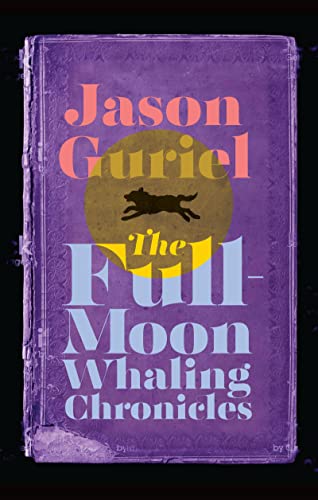
The Full-Moon Whaling Chronicles by Jason Guriel
This book is written in verse. Not only that, but Guriel writes in iambic pentameter with rhymed couplets for 381 pages. It’s worth reading for that reason alone. But the story will grab you as well.
The Full-Moon Whaling Chronicles is a dystopia/fantasy book set in 2070. The water levels have risen. Newfoundland is gone. People are being shrunken down into “Bonsai housing.” Montreal is a huge pit filled with “pitizens” who live in pods, which are spherical with rooms that come to you as you walk, like a hamster wheel. Because you can’t get wifi in the pit, teens send “bleats” to each other that are delivered by “kids” who wear special sneakers made out of “wise weave.” Some people have “smart eyes” with which they can receive “eyemail.” All the garbage that has been sent to space has blocked out much of the sun, moon, and stars. Traditional books as we know them now are called “dumb print” or “bot-free print.” There’s a book within the book that is about a group of teen werewolves who live in a fishing village. There is so much more cleverness in this book that I’ll leave for you to discover on your own.
The booth had scanned Kaye’s “chasms”– / Basically, the gulfs between her atoms– / Then collapsed the gulfs a bit so she / Could fit inside her dorm. She’d read of flea- / Sized families, thousands to a tenement / In less developed countries. Negligent / (Or fascist) governments were shrinking people / To a scale that had been deemed illegal. / Several global treaties had decreed / That bonsai hives designed for those in need / Could only shrink a person to a size / A healthy human eye could scrutinize.
In an interview on CBC radio, Jason Guriel was asked why he wrote a whole novel in iambic pentameter with rhyming couplets. His answer was that he “wanted to write something that could move outside of the poetry subculture.” He wanted to write something fun and exciting enough that non-poetry readers would pick it up and enjoy it as well as poetry readers. I’d say he’s succeeded.
Thank you to Biblioasis for sending me copies of these books!
Other brilliant Biblioasis books I’ve written about over the years:
- Confessions With Keith by Pauline Holdstock
- Ordinary Wonder Tales by Emily Urquhart
- Querelle of Roberval by Kevin Lambert
- Chemical Valley by David Huebert
- Aubrey McKee by Alex Pugsley
- If You Hear Me by Pascale Quivigar
- Late Breaking by K.D. Miller
- Bad Things Happen by Kris Bertin
- The Party Wall by Catherine Leroux
 Consumed by Ink
Very much like the sound of those short stories. I’m very impressed that you can review so long after reading. My notes tend to be illegible, even to be, but they do fix the book in my brain for a while!
I actually ended up re-reading a few of the stories before writing about them. I wasn’t planning to, but they were still so good! 🙂
I love the sound of both the novels (not that I even know what an iambic pentameter is). Did you see in today’s news the story of a French 9 year old left to live two years on his own – and still going to school every day! Stories about kids without adults are … fantastic? Or is that just the obliviousness of an old, middle class, white guy.
I’m always intrigued by stories about kids left without adults, too. What will they do? How do they think? In a recent audiobook I was listening to, there were a couple of stories about children being neglected but continuing on like things were normal so that they wouldn’t be taken away from their home and each other. It’s amazing to hear their stories!
These all sound great, though I think I’d head to the short stories first.
I can’t wait to read more from Lisa Alward!
They all sound interesting but I think Cocktail appeals the most to me!
I’m glad I finally got to write about it – it seems to be a popular choice! 🙂
You make these all sound so good! I’ve wanted to read The Future since it was longlisted for Canada Reads – I’m waiting on a library copy. And an entire book in iambic pentameter! That’s quite a project?
I can’t even imagine how hard that would have been. In an interview, Guriel said it was slow going at first, but got faster once he was into the rhythm of the story. I wonder if all his thoughts started coming to him in rhyming couplets!
The Future has been doing really well since being shortlisted for Canada Reads, which I’m so happy about because she’s such a good writer – she deserves the attention!
I can see how it would be something you’d get into a rhythm of. I bet it would be hard to stop internally counting syllables and thinking about rhymes!
Quite an eclectic mix of books here! Even though I don’t think any of them are for me, it’s great to see a Canadian publisher putting out these works.
I always love to see what Biblioasis is up to!
Absolutely one of my favourite indie presses: such a dramatic and impressive list. These three show what variety they have to offer in one swoop, from stories to speculative fiction to verse novels. The first two I’ve read and I share your recommendation of them…Guriel’s project sounds fascinating and I’m all for breaking down the barriers between prose and poetry (I feel it too). Its cover is very striking too.
If you’re considering reading Guriel’s book, you might want to check out Forgotten Work – the verse novel he wrote before this one. I didn’t have time to read both, but you might!