
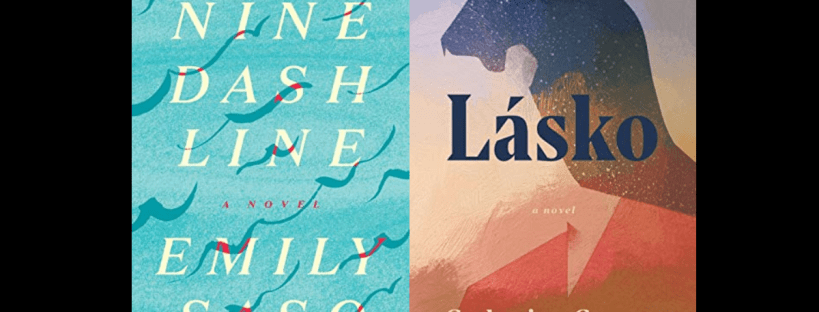

Lásko by Catherine Cooper
Lásko (which means “love” in Czech) is a story that surprised me and took me to places I wasn’t expecting.
When Maja was seven, her mother disappeared. Now that Maja is grown, she has the same urge to leave her fiancé in Canada and disappear. I imagined a story in which Maja might go to her mother’s home country, the Czech Republic, and search for clues about her mother and her heritage. There is a little of that, but mostly, I got something very different.
After Leaving Canada, Maja first travels to Australia to visit her aunt. There, she attends a dance workshop where she meets a Czech man named Kuba. They meet again in Prague and fall in love.
Kuba is a rising leader in Czech New Age circles. Maja is as drawn in by him as everyone else, but feels overwhelmed by it all. Kuba’s life is full of other people, many of whom he has strong connections with. Maja feels insecure about herself and can’t understand why Kuba has chosen her when he is surrounded by so many beautiful women who are obviously taken with him. She feels torn: torn between joining the activities or sitting them out; staying in Czech with Kuba or going home; trusting Kuba or being suspicious of his close relationships with these other women. She doesn’t know what she wants or what’s good for her.
There are several things going on in this book that I could talk about, but what stands out most to me is Maja’s unrest, her self-disgust, her anger, confusion and passivity. She thinks she’s searching for answers about her mother but really she’s searching for herself. She thinks she’s in love with Kuba, but really she’s vulnerable and easily influenced and she doesn’t know how to break herself free of it. She doesn’t know if she wants to break herself free of it because that would mean more restlessness and an unknowable future; it would mean having to face herself and her responsibilities. (Maja is supposed to be writing a book–for which she has been given an advance–but her writing has fallen by the wayside as she rides out the weather system that is Kuba.)
There’s something thrilling about the idea of giving my life over to his visions, probably because I don’t have any of my own anymore.
Maja’s confusion, frustration, disgust, and anger are palpable and relatable. Be ready to feel all the emotions – she will elicit your sympathy and compassion, your anger and frustration all at the same time.
Maybe the best we can do sometimes is accept the fact that we don’t have our lives all figured out.
Since I have nowhere else to go, I try going toward the part of myself I’m so disgusted by–the part that wants to hide, that wants too much to be seen, that feels weird and embarrassing, that feels superior and self-righteous, that wants to have a formula for everything, to arrive and know. I get close to her and tell her I don’t know how to love her yet, but I’m going to try to stop hurting her.
Favourite line: “The only thing left–the only thing that’s ever been left when there’s nothing else left–was books.”
Runner up: “I believe I could be totally compassionate and loving if people could stop being such motherf*cking assholes.”

Nine Dash Line by Emily Saso
I didn’t know about the nine-dash line and the fight for dominance in the South China Sea before reading this book, and for that reason alone I’m glad to have read it. But that is just the backdrop to this novel – at the heart is a man and a woman, in very different circumstances, who want to belong and to be free.
Jess doesn’t make plans. She follows orders, and she is good at it. She likes it, the structure that orders bring to the chaos inside her.
If she didn’t follow Sacks’s plan for her, what was the point of any of it? What was the point of her?
When the story opens, Jess is on a raft somewhere in the South China Sea. It’s soon clear that she’s a US intelligence officer on a top-secret mission and things are not going as planned.
At the same time, a man named Zi Shan has been exiled from communist China and has been deserted on a coral reef in the middle of the sea. He is to spend his time building up the reef into a more substantial island.
He could continue to run, certainly, but only in circles. He stops and spins like a broken compass, but west, east, south, north, it does not matter; in every direction there is only sea. No land in sight, no refuge, no civilization, not even a sound but the breeze and the lapping of waves. Not even the lonely call of a sea bird, or the horn of a passing ship. Only coral, sand, raging sun, white caps off in the incalculable distance, and horizon.
As the fight for their individual survival unfolds, their back stories open up so the reader understands how they both got to where they are today. And how their fates are intertwined.
I love the unique setting of this book–the tiny islands and reefs of the South China Sea–and learning about the geopolitics of 1980s Southeast Asia. But, best of all, this book offers introspection of the characters along with the action and thrills of a spy novel.
A favourite part of the book for me were the crabs that keep Zi Shan company on his tiny reef.
…he rolls over on his side, his ear pressed to the sand, He hears the crabs clittering beneath him, and he interrupts, “This is hell, isn’t it?” he asks them. “It’s not being trapped in a thunder cloud forever like my mother’s story. Hell is here, it’s this place. I died that day, the day of my crime against the party, and this reef is my eternal punishment.”
Silence as the crabs confer. Then a shift from below, the sand moving atop their subterranean backs. The crabs emerge, one thousand of them, and form a translucent, jittering circle around Zi Shan. There is no hell or heaven, they tell him. The gods are real, but they are not in the clouds as your mother told you. The gods are in the sea, and the sea is their sweat, from the exertion it takes to hold the world together.
A favourite passage: “Zi Shan wonders if there is such a thing as love, pure love. He thinks through his life and thinks that it is impossible. Love/hate. Love/fear. Love/shame. There are always lines cutting love in half.”

Thank you to Freehand Books for sending me copies of these books!
Other great books by Freehand I’ve written about here:
- Coq by Ali Bryan
- If Sylvie Had Nine Lives by Leona Theis
- Speechless by Anne Simpson
- Watershed by Doreen Vanderstoop
- This Has Nothing To Do With You by Lauren Carter
- Hummingbird by Devin Krukoff
- The Figgs by Ali Bryan
- Homes by Abu Bakr Al Rabeeah and Winnie Yeung
- Dazzle Patterns by Alison Watts
- Great Adventures for the Faint of Heart by Cary Fagan
- This Strange Visible Air by Sharon Butala
 Consumed by Ink
The Cooper appeals most out of these two. Those quotes you’ve pulled out are great, particularly the two favourite lines.
Those are great, aren’t they?
Cooper has a way of pulling you along with her prose, making it hard to put the book down.
That Cooper sounds very interesting. You always choose great quotes!
Thanks, Cathy! There were a lot of good ones to choose from!
Freehand is a wonderful publisher, isn’t it? I love them too.
Cathy is right – you do choose amazing quotes!
Freehand is wonderful! 🙂
You’ve had lots of good luck with this publisher. These both sound interesting!
I’m always surprised when I look back to see what other books I’ve read from the same publisher and there’s a whole list of amazing books. It makes me so happy!
Emily Saso’s novel is terrific; I thoroughly enjoyed it. And what a different kind of story compared to her debut. Definitely an author worth following.
I enjoyed Cooper’s debut novel too for the most part, but I only just got a copy of this novel a couple of weeks ago. Disgust is such a strong word, so I’m very curious to meet this character on the page. Although it sounds like she might not be very easy company…
You’re right… she’s not always easy to be with. But I found her almost always relatable. I could either understand her thoughts and feelings or–at least–easily imagine them, which made it easier to be with her for so long.