
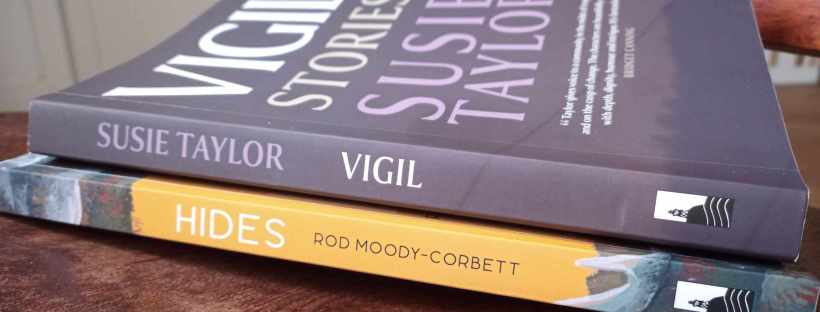
Two Newfoundland novels with a cast of male characters. Vigil takes on the small town, working class life, while Hides takes on middle class families from St. John’s. Neither of them show a clear pathway to happiness and success, but both excel at the use of language and humour to tell their stories.

Vigil: Stories by Susie Taylor
An excellent collection of linked stories from the author of Even Weirder Than Before (2019).
Each story in Vigil places you in the fictional town of Bay Mal Verde, a town struggling with addiction, violence, and poverty. The characters in this town are doing what they feel they have to do to get by, whether that’s dealing drugs to make some money or taking pills to fill the emptiness. Some of the characters stand out as leaders in the community, while others blindly follow wherever they are led. Some have already given up, while others are still holding on to hope. They want what everyone wants: to love and to belong.
“Her [Bay Mal Verde] current brood is suffering, and she sees it. She doesn’t feed them well; they live off cheap white bread and hope. Her grocery stores have shut down, and there isn’t even a bus she can stick them on if they need a trip to the doctor’s. Her kids run wild and she finds it hard to keep track of their needs and desires. Too many of them are slipping through the cracks… “I am too old for this,” she moans.”
Taylor’s characters have had hard lives and walk the complex line between good and bad. Kev, with his muscles and tattoos, is not bothered about asking high school kids to do his drug deliveries for him, but he also spends time every day making pandemic deliveries around the neighbourhood. “He Facetimes [his mother] at least once a day, but she likes to see him in the flesh. He got her a box of medical masks and he makes her wear one even when they’re talking outside, although she pulls it down under her mouth every time she speaks.” Kev’s main guy Carter’s got anger issues and has spent time in prison, but is desperate to find a soft place to land. Ryan managed to get away to university for a while, but the next story we see Ryan in he’s carrying out a hot, grueling shift as a garbage man; we can only guess at how he got from one place in his life to the other.
If there’s one character who links them all together, it’s Stevie. He was one of the group of boys that grew up together, but is depicted as the sniveling runt of the group whom the others picked on and felt sorry for at the same time. In “Vigil”–the second story in the book–the community is holding a vigil for Stevie at the Ultramar where he often hung out. He’s been missing for a week, presumed dead by many, known to be dead by a very few.
“They rolled around the neighbourhood together, a clump of boy. They would shed a boy at one house and pick a new one up at the next corner. They gave off a smell of Vienna sausages, farts, and fabric softener.”
It’s not surprising that young folk in Bay Mal Verde have a tough time finding ways to succeed in life when they have parents and guardians who drink and gamble, hit them on the daily, and take them out to commit crimes. In addition, there are very few places in town to work and it’s a big cost to take classes in St. John’s. However, beneath the tough outer layer of life in Bay Mal Verde, there is evidence of warmth and love between the characters that hints at the connections within and between families who have been there with and for each other for generations.
“Resurrection”–the last story in the book–offers the reader some closure on many of the main characters in a most unexpected way. If even Stevie can find it in his maggot-infested heart to forgive, than surely there’s hope for the rest of them.
“Stevie rises again, walking down Water Street early on a Tuesday morning, like a second-rate and unwanted Jesus.”
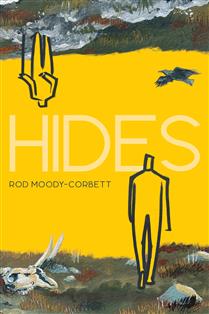
Hides by Rod Moody-Corbett
If there’s one thing you can say from reading his debut novel, it’s that Rod Moody-Corbett loves words; interesting words, words that sound good. This reader had to spend some extra time reading sentences over again, either to be sure I’d gotten the meaning or because the sentence was beautiful and deserved to be read more than once.
If there’s another thing you might say about it, it’s that it paints a pretty sad picture of the world of men (based on the characters in the novel). The narrator is one of a group of three men from St. John’s, Newfoundland who have been friends for over forty years, but time and loss and life does not always treat us well (or maybe we mishandle it) and the quality of their friendship is not what it used to be.
The book opens with the narrator being asked to come spend a week at a luxury hunting resort with his friends to commemorate the loss of Willis’s son Travis who was killed in a mass shooting while at university in Alberta. The narrator is trying to find excuses not to go, not because he questions the appropriateness of the commemoration activity (which he does), but because he feels safer hiding out in his small apartment by himself in Calgary where no one from home needs to know how much of a failure he really is.
It’s these insecurities that continue to play out in the narrator as he goes home to Newfoundland, visits his father, then on to the resort where he spends too much time thinking about himself and self medicating with alcohol and weed. His attitude at the resort being, more or less, well I’m here, aren’t I? He has no idea what to say or how to act toward his friend or his father and is too proud to admit it.
Willis finally confronts him. “ ‘There’s something sinister in you,’ Willis had said; I wasn’t sure I disagreed… I’d hardened, grown steadily more cynical and remote… Where once I infused a sense of calm, soothing feuds and mending frayed feelings, now I seemed a perilous agent of chaos, an agitator of abject brawling, silence, and spite. What’d happened to me?” And, more importantly, what can be done about it?
Despite the grief and loneliness in this novel, there’s a lot of humour and sharp dialogue to keep things from feeling too heavy. There’s also a lot more going on than what I’ve chosen to focus on: There’s unresolved issues between the narrator and his father; grief over the loss of his mother; Willis’s wife and other children have things going on; their friend Baker deserves a book of his own; and then there is Dr. Judith Muir, the eccentric owner of the hunting resort; not to mention the politically and climatically charged landscape of the country on the very day they’re relinquishing their cell phones to Judith and going off-grid.
My favourite line: “My teeth felt very present in my mouth, present but displaced, as though sitting in unassigned seats.” My teeth have felt this way! Have yours?
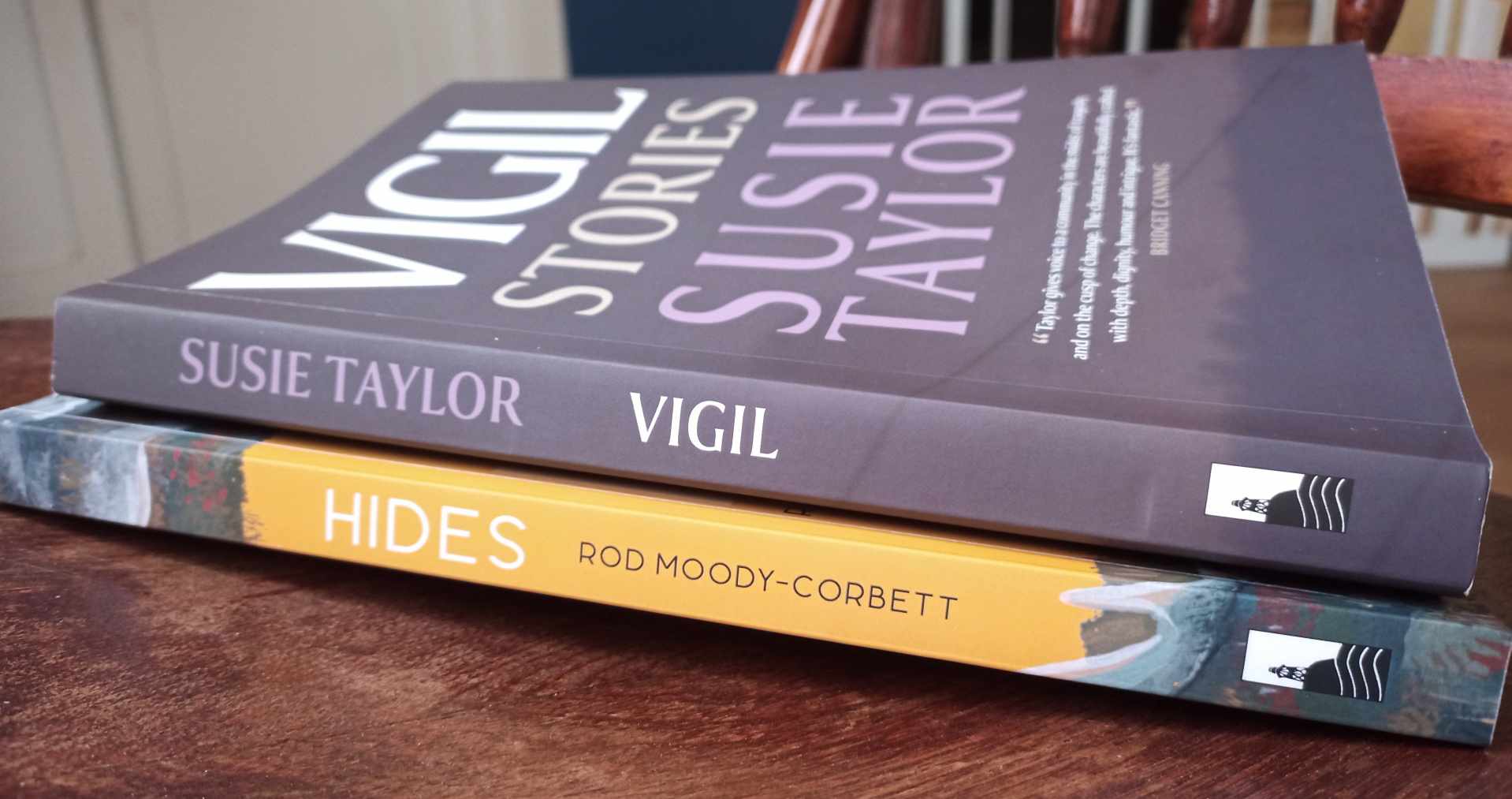
Thanks to Breakwater Books for sending me copies of these books!
 Consumed by Ink
Uh oh, I just skip-read your last post because I’m debating whether to read Lessons in Chemistry, and now I’ve squeezed shut my eyes through this one because I’m reading the stories right now and I have to write my own review of Hides in the next couple of weeks. Hopefully I will remember to come back when I can LOOK. lol But what I can say is that I’ve found Breakwater’s books to be consistently high quality. The language matters, the story matters: it all matters.
I agree! I love Breakwater Books! 🙂
Wow, very powerful quote there – ‘second rate and unwanted Jesus’. I love that!!! Sounds like a really good book of stories – difficult to read I’m sure, but worthwhile.
It was actually easy to read – the author has so much love for her characters!
Don’t you love it when you want to linger over beautiful sentences?
Absolutely! 🙂